
Palatability | August 27, 2026
Animal-Free Pet Food: Can It Stay Palatable Without Plasma?
Palatability is not only texture. It is also taste and aroma. But removing animal blood plasma from a wet food is easy; removing it without the animal noticing is the hard part, and that is where the whole replacement problem is really decided.
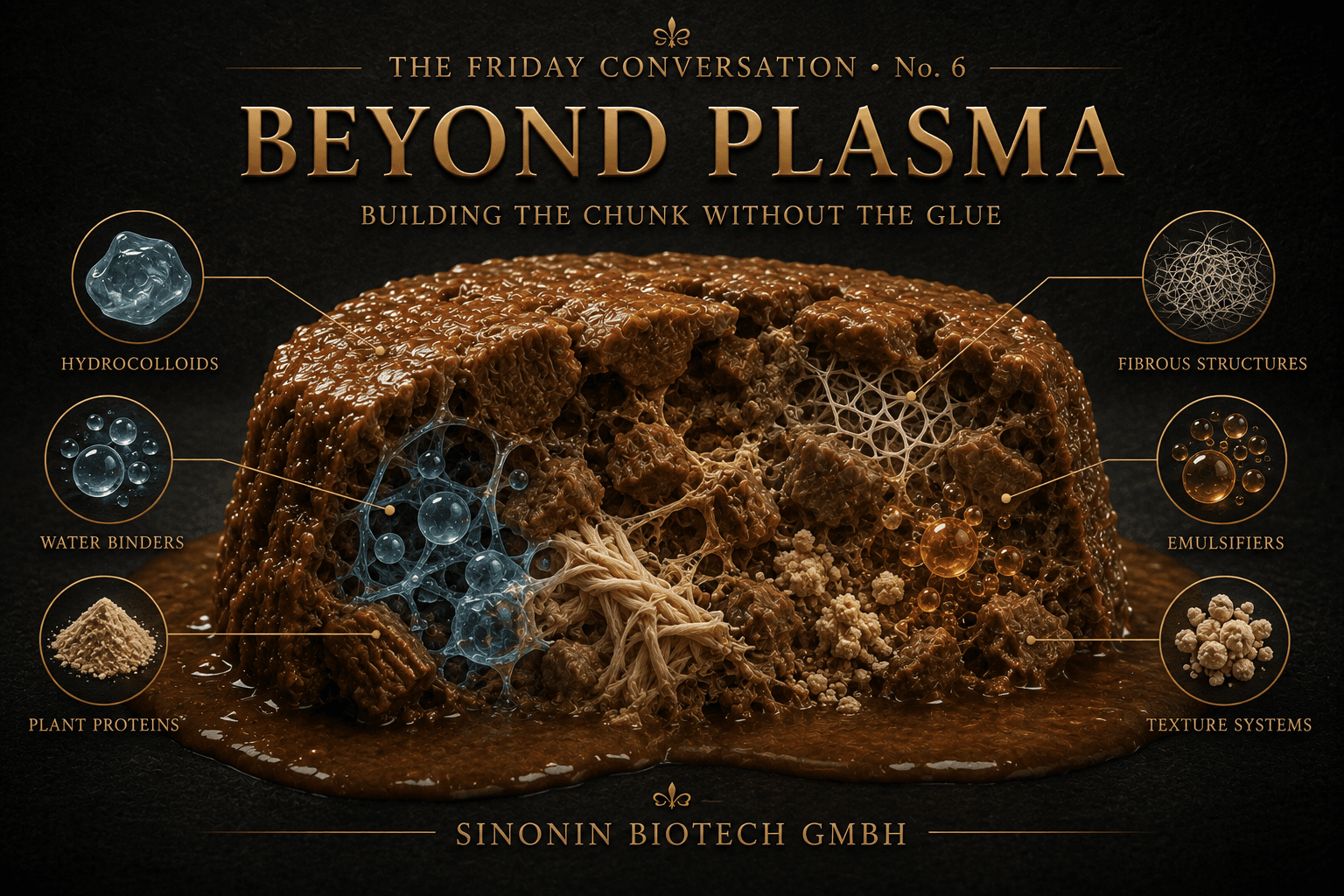
The plant kingdom supplies almost every strand. Whether one protein locks the net, or the ensemble does, is the open question.
A soybean contains a protein called albumin. It contains proteins called globulins. Open a seed catalogue of the plant kingdom and you will find, listed in plain type, the same words we use for the proteins in blood: albumin, globulin, and, if you go looking, even a red pigment that carries iron in a ring of haem, the leghaemoglobin that gives a soy nodule its bloody blush and gives a certain famous plant burger its bleed. On paper, the plant has everything the plasma has. The names line up.
So the obvious question, the one a formulator asks in the first meeting, is why we cannot simply reach for the plant version and be done with it. The plant makes albumin. Plasma is largely albumin. Why is this hard?
It is hard because a name is not a function. The word albumin, in a seed, means only that the protein dissolves in water and sets when you heat it. It was borrowed, a century ago, precisely because those plant proteins reminded chemists of the egg. The word tells you how the protein behaves in a test tube, not what job it does in a chunk. Plant albumin and blood albumin are cousins in name and strangers in work. Leghaemoglobin made the colour of blood, and it made it convincingly enough to sell. It did not make blood.
The plant has albumin. The blood has albumin. Cousins in name, strangers in work.
And that is the whole essay in a sentence, so let me say it plainly before we go further. We are not, in this series, trying to replace a protein. We are trying to replace what a protein does, in a chunk, to an animal that will either finish the bowl or walk away from it. The plasma question was never really about plasma. It was about the bowl.
❦
Movement I · THE ANIMAL IN THE CHUNK
Plasma is animal blood, and there is a great deal of animal in it: a tonne of the powder is the recovered plasma of something like three thousand pigs, or nine hundred cattle, though not one of them died for it, since they were killed for meat and the blood is only what ran out. That last point matters, because it tells you what the animal-free project is and is not about. It is not about saving those animals; the meat industry will kill them with or without a use for their blood. It is about something simpler and, in its way, harder to argue with. A growing number of people want to feed their animals a diet with nothing in it that was ever an animal, for reasons of their own that the industry does not get to overrule, and plasma is the quiet animal ingredient sitting in the one product they cannot yet have.
That product is the wet chunk. Structurally, plant-based kibble is largely a solved engineering problem. The wet chunk in gravy is another matter: holding together, holding its water, keeping its shape through the retort and the shelf and the fork, it is the wall the vegan project keeps hitting, and plasma is mortared into it.
No animal dies for its plasma. They die for meat, and the blood is what runs out.
So the ambition is easy to state and hard to meet. We want the chunk without the animal. We want it to bind, to hold, to bite, and above all to be eaten, with nothing in it that was ever an animal. What we are really asking for, though we rarely put it this baldly, is an animal-free plasma: something that is not blood and has never been near an animal, but that does, in the chunk, the work that blood did. The question is whether that thing can exist. And that is where the honest trouble begins.
❦
Movement II · THE THINGS THAT ALMOST WORK
The first instinct is to reach for a gum. Our pantry is full of them, and several will hold a chunk together, so let me be fair to each before I say why fair is not enough.
Gellan is the one I reach for first, partly because it is already, in its way, an animal-free triumph. It is not dug or harvested; it is fermented, spun out of a bacterium in a tank, which is exactly the kind of process the back half of this essay will end up praising. It gels. It holds. But ask it how, and the trouble starts. High-acyl gellan sets into something soft and elastic that melts again when you warm it. Low-acyl gellan sets into something firmer that does not melt, but is stiff and brittle where the chunk wants to be yielding. And either way it will only gel if the water around it carries the right ions, calcium or potassium, in the right amount, which a wet recipe does not always politely supply. It is a gel with conditions.
Methylcellulose is stranger still, and it is the darling of the plant-burger, so it deserves a hearing. It does something almost no other food ingredient does: it sets when you heat it and melts when you cool it. That is not a typo. The burger holds on the grill because the methylcellulose is gelling in the heat, and it is at its most fragile on the plate as it cools toward the temperature at which it will actually be eaten. For a patty eaten hot off the flame, that can be made to work. For a chunk in gravy that sits in a bowl at room temperature while a cat decides whether to bother, a binder that is firmest when hot and weakest when cool is solving the wrong half of the problem.
And this is the pattern, once you line the candidates up. Gelatine sets as it cools and melts as it warms. Methylcellulose sets as it warms and melts as it cools. Gellan sets on cooling and either melts again or turns brittle, and only if the ions are right. Every one of them gels. Not one of them gels the way plasma does, which is to set when heated and then stay set, permanently and elastically, through the retort and the cooling and the shelf, holding water and fat in a network that does not care what the temperature does next. The plant proteins can be pressed into service too, and some of them, potato protein in particular, will form a true heat-set gel of their own. But pressed into the wet chunk, asked to survive the retort and the flood of gravy and still give a bite, they arrive short in one way or another, and the formulator ends up propping them with exactly the gums above.
So the roster is not empty. It is worse than empty. It is full of ingredients that each do part of the job and none of which does the whole of it, which is why the honest version of a plasma-free chunk today is not one clever replacement but a committee of them, a little gellan for set, an insoluble cellulose fibre working as a sponge to hold the water and steady the texture, a protein for body, a soluble cellulose gum to thicken the gravy and paper over the difference, each covering for what the others lack. And a committee is not a keystone. It is what you build when you do not have one.
Every one of them gels. Not one of them gels the way plasma does.
Which forces the real question, the one the gums cannot answer. What is it, exactly, that plasma has and none of these has? What is the single thing we keep failing to reproduce?
❦
Movement III · THE PROTEIN I WAS TEMPTED TO NAME
There is a protein it is very tempting to name here, and I am going to name it, but I am going to be honest about how much weight the name can bear.
Plasma is largely albumin, and the plant has albumin, and we have already seen that the shared name is a coincidence of solubility rather than a shared job. But albumin is not, on its own, the obvious source of the one property the committee cannot reproduce: the setting into an elastic, water-holding solid that survives the retort and does not come apart in the gravy. And there is a candidate for that property with a very suggestive credential. Take fibrinogen out of plasma and what remains is called serum. The two fluids differ by essentially that one protein, and they behave differently in a gel. Fibrinogen is also a protein the plant kingdom has never made, and never had any reason to make, because plants do not bleed. So the temptation is obvious. Name fibrinogen the keystone, ferment that one protein, and the animal-free chunk falls into place.
Here is why I will not quite say that, and the reason matters more than the conclusion. In the body, fibrinogen does something very specific and very beautiful. When a vessel is breached, an enzyme called thrombin snips two small peptides from the molecule, and the sticky ends left behind reach out, clasp their neighbours, and assemble, without further instruction, into an insoluble elastic mesh. That is the clot, and it is genuinely a thing no plant protein does. But that is physiology, and a chunk in a can is not a wound. What happens in the powder is subtler than it first looks, and it took me a moment to get it right. The plasma is collected with an anticoagulant, commonly citrate or a phosphate, which does not attack the clotting proteins but locks away the calcium the coagulation cascade needs to proceed. So fibrinogen enters processing largely as fibrinogen, whole and uncleaved, rather than as a pre-formed fibrin clot, and thrombin is never generated from its precursor to do the cleaving. Spray-drying can preserve a good deal of protein functionality, though how much coagulation activity in particular survives depends on the process. What matters for the chunk is the step that comes next. The set that forms in the retort is principally a heat-induced protein gel, not a physiological fibrin clot: wet heat drives the whole population of plasma proteins, albumin and globulins and the intact fibrinogen together, into a collective aggregation, a gel formed by denaturation rather than by enzyme. And here is the twist that keeps fibrinogen in the frame even so, because it arrives whole rather than spent, it enters that thermal gelation as a full and unusually gelation-active protein. Fibrinogen clearly contributes materially to how the network behaves. But the published work on how plasma and its isolated fractions gel points just as strongly to interactions among the fractions, fibrinogen and albumin and the globulins influencing one another as they denature, as to any single protein doing the work alone, and only that reading is honest on what we actually know.
And there is a deeper reason to distrust the tidy answer, which is that I have made this mistake before, one conversation ago. In writing about meat I argued at length that reducing a food to its most quotable constituent misses the emergent system, that the value is in the ensemble and not the headline molecule. It would be a poor kind of consistency to spend that essay warning against reductionism and then open this one by declaring that plasma is really just fibrinogen in an ensemble. Plasma is a multi-protein system. Its gelation is collective. Some plant proteins do form strong, irreversible, heat-set networks of their own, so the point is not that plants cannot gel. It is more specific and, I think, stronger: no single plant ingredient appears to reproduce the full multifunctional behaviour of plasma under this process context, the setting and the water-holding and the fat-holding and the bite, all at once and all through the retort. Which single protein, if any, carries the irreplaceable part of that is a question I can pose sharply but cannot yet close, and I would rather pose it sharply than close it dishonestly.
The plant never made fibrinogen. Whether fibrinogen alone makes the chunk is a different question.
I can say all of this with more than a reader’s confidence, because I have been down the near end of this road myself. Some years ago I worked on, and hold a patent for, a way of building the binding function of a wet pet food from a denatured whey protein rather than from blood, a micro-particulate protein engineered to set into the kind of matrix a chunk needs. It works, within its limits, and I am glad of it. But it taught me the lesson this essay is circling. You can engineer a protein to do a good deal of what plasma does. What you cannot easily do is get all of it, and get it from a plant, and get it animal-free, all at once. Whey is milk. Milk is an animal. Solving the plasma problem is not the same as solving the animal problem, and rebuilding one function is not the same as rebuilding the system. The binding can be reconstructed. The demand was never only for binding.
So the honest position, at the end of the roster and the patents and the gums, is this. The plant cupboard does not hold whatever it is that plasma has. A committee of hydrocolloids is a confession that we are working around an absence rather than filling it. And the absence has a named candidate, fibrinogen, with a real credential and a case that the evidence complicates rather than closes. Which leaves one door in the building we have not yet tried to open, and a more careful question to carry through it.
❦
Movement IV · THE DOOR MARKED FERMENTATION
The careful question is this. If some part of what plasma does turns out to be genuinely irreplaceable, some protein or small set of proteins that no plant makes and no gum imitates, are we then simply stuck, holding a wet chunk we can build almost but not quite well enough. And the answer, built quietly over the last decade, is no. Not if we stop asking the plant to be the source at all.
We already make animal proteins without animals. Not by growing the animal, and not by finding a plant that fakes it, but by handing the gene to a microbe and letting the microbe do the work. The whey protein in a growing number of ice creams was never in a cow; it was fermented from a fungus carrying the instructions for it. Egg-white protein is being made the same way, and so, in laboratories and increasingly at scale, is serum albumin itself, the most abundant protein in the very plasma this essay has spent two instalments discussing. The proteins that were said to be too structurally clever for a plant to replace are not being replaced. They are being copied, faithfully, by organisms that can, increasingly, be taught to make proteins once thought inseparable from the animal.
Which turns the animal-free chunk from a search into a construction, and changes the questions we ask of it. Not what replaces plasma, but which of plasma’s jobs actually matter to the animal, and what is the minimum animal-free system that can reproduce the functions that matter. Can plant protein carry the body while an insoluble fibre and a soluble gum manage the water? Can fat be placed and stabilised by design rather than by luck? And for whatever network function survives all of that as genuinely irreplaceable, the part the committee keeps failing to cover, can a protein grown in a tank stand in for one drained from an animal?
If that protein turns out to be fibrinogen, we ferment fibrinogen. If it turns out to be fibrinogen doing its work only in the company of others, we learn that, and we build the company too. The tool does not care which answer the evidence returns. It cares only that the answer, once known, can be made without the animal.
We are not looking for the plant that can be plasma. We are rebuilding what plasma did, job by job.
I will not pretend this is finished, or easy, or that I am a disinterested narrator of it. It is the problem I have given my working life to, and there is a name waiting on it for when the science is ready. But a name is a promissory note, and this essay is not the place to cash it. The honest thing to say is only that the door exists, that it is not locked, and that behind it is not a single clever substitution but a discipline: find the jobs that matter, identify the few that only an animal protein has ever done, and grow those and only those, while the plant kingdom does the rest of the work it was always able to do.
There is a reason this door has stayed shut, and it is not that no one noticed it. Plasma begins with an extraordinarily cheap raw material, blood from a slaughter that was going to happen anyway. The powder itself is not free; it has to be collected hygienically, separated, concentrated, stabilised and spray-dried, and those operations carry real cost. But even so, precision fermentation begins at a structural disadvantage, because it must deliberately manufacture, in a tank and on an energy bill, a protein whose biological synthesis the animal has already paid for. So the fermented protein does not only have to work. It has to earn its place against a mature co-product whose hardest cost, the making of the protein itself, was settled long ago inside a living body, and it has to do so for people who have decided, for reasons of their own, that a co-product of slaughter is still too much animal to accept. That is a real bar, and pretending it is low would be its own kind of dishonesty. But it is a bar that novel ingredients have cleared before, once the demand was certain enough to pull the cost of making them down.
And here the engineering has to hand the question back, because structure is not the same as palatability. A chunk can pass every instrument in the laboratory, match the old one for hardness and springiness and water held, and still be met at the bowl with the particular indifference a cat reserves for food that is almost right. Plasma may carry signals we have not fully named, chemical as much as physical, and reconstructing its texture job by job may still leave those signals behind. There is already a hint of this in the feeding data, where cats have preferred plasma-bound wet food over the same recipe bound with wheat gluten, and where some of plasma’s biological effects appear to survive the can, which tells us the ingredient was never doing only mechanical work. The rheometer can tell us whether we rebuilt the chunk. It cannot tell us whether we rebuilt the food. Rebuilding what a food does is not quite the same as rebuilding what an animal recognises.
And there is one more reason to do this now rather than later, which is that the concession this essay opened with has an expiry date. I said at the start that no animal dies for its plasma, that the beast is killed for meat and the blood is only what runs out, and that is true today. But it is true only for as long as meat means slaughter. We are already producing cultivated chicken from animal cells, while companies work towards structured cuts of cultivated beef, learning, tissue by tissue, to make meat without killing the animal it came from. Plasma is just another tissue, a fluid one. If that promise holds, and it is still a promise, resting on the whole cell-culture logic proving genuinely clean and food-grade at scale, then the blood stops being a byproduct that was going to run out anyway. An animal-free steak in a gravy thickened with drained blood is not a destination. It is a halfway house.
But notice what that world does not do. It does not hand us a bowl of prime cultured muscle and call it dinner. Cultured meat is designer meat, grown almost without waste, and that is precisely why it will not, on its own, feed a cat. A prime cut is not a balanced diet; it is muscle, and a cat needs the whole formulated matrix around it, the organ nutrients and the taurine and the minerals and the fat and the moisture, composed and bound into something shelf-stable and palatable. That formulation does not disappear when the slaughterhouse does. If anything the cleaner technology frees land and feed and effort for exactly the novel ingredients this essay has been circling. The chunk still has to be built and held together, from material that increasingly will not have come from an animal at all. The binding problem is older than slaughter and outlasts it, because it belongs not to waste but to formulation itself.
And so we arrive back where the last essay left us, with the question turned finally right way round. We spent this whole conversation asking how to replace plasma, and the asking was half the error. We were never going to replace the ingredient, and we were never going to find its single secret and copy it in isolation. The ingredient is blood, an ensemble, and blood is not available to the animal-free chunk on any terms. What we can do, if we are careful about it, is reproduce not the ingredient but the jobs the ingredient did, drawing each from the source that does it most honestly, and let the plants do everything they were always waiting to help with.
Whether that chunk, when it is finally set and sliced and dropped into its gravy, is one an animal will finish, is not a question chemistry can answer. It is the one the instruments cannot reach, and it belongs, as it always has in this trade, to a single judge, sitting in front of a bowl, deciding in the only currency that has ever mattered whether to eat.
The bowl, as always, will decide.
References
1. Osborne, T.B. (1924). The Vegetable Proteins, 2nd ed. Longmans, Green & Co., London. (The albumin, globulin, prolamin and glutelin solubility classification of plant seed proteins.)
2. Shewry, P.R., Napier, J.A. & Tatham, A.S. (1995). Seed storage proteins: structures and biosynthesis. The Plant Cell 7(7):945-956. doi:10.1105/tpc.7.7.945
3. Ockerman, H.W. & Hansen, C.L. (2000). Animal By-Product Processing and Utilization. CRC Press. (Slaughter blood yields; plasma as a recovered co-product.)
4. Blázquez, E., Rodríguez, C., Ródenas, J., Segalés, J., Pujols, J. & Polo, J. (2020). Biosafety steps in the manufacturing process of spray-dried plasma: a review with emphasis on the use of ultraviolet irradiation as a redundant biosafety procedure. Porcine Health Management 6:24. doi:10.1186/s40813-020-00155-1
5. Dàvila, E., Parés, D., Cuvelier, G. & Relkin, P. (2007). Heat-induced gelation of porcine blood plasma proteins as affected by pH. Meat Science 76(2):216-225. doi:10.1016/j.meatsci.2006.11.002
6. Polo, J., Rodríguez, C., Saborido, N. & Ródenas, J. (2005). Functional properties of spray-dried animal plasma in canned petfood. Animal Feed Science and Technology 122(3-4):331-343. doi:10.1016/j.anifeedsci.2005.03.002
7. Weisel, J.W. & Litvinov, R.I. (2013). Mechanisms of fibrin polymerization and clinical implications. Blood 121(10):1712-1719. doi:10.1182/blood-2012-09-306639
8. Aro, N., Ercili-Cura, D., Andberg, M., Silventoinen, P., Lille, M., Hosia, W., Nordlund, E. & Landowski, C.P. (2023). Production of bovine beta-lactoglobulin and hen egg ovalbumin by Trichoderma reesei using precision fermentation technology and testing of their techno-functional properties. Food Research International 163:112131. doi:10.1016/j.foodres.2022.112131
9. Knychala, M.M., Boing, L.A., Ienczak, J.L., Trichez, D. & Stambuk, B.U. (2024). Precision Fermentation as an Alternative to Animal Protein, a Review. Fermentation 10(6):315. doi:10.3390/fermentation10060315
10. Rodríguez, C., Saborido, N., Ródenas, J. & Polo, J. (2016). Effects of spray-dried animal plasma on food intake and apparent nutrient digestibility by cats when added to a wet pet food recipe. Animal Feed Science and Technology 216:243-250. doi:10.1016/j.anifeedsci.2016.03.026
11. Cheison, S.C. & Murgueytio Riofrio, E.L. (2024). Pet Food Product. US Patent 12,096,781 B2 (filed 16 August 2018; granted 24 September 2024). Assignee: Mars, Incorporated.
❦
Dr. rer. nat. habil. Dr. Seronei Chelulei Cheison is the founder and Chief Executive Officer of Sinonin Biotech GmbH, a biotechnology company focused on alternative protein and palatability enhancer innovation and application for petfood formulations. He formerly led alternative protein and palatant development projects at the Mars Petcare Global Innovation Centre in Verden, and spent close to two decades in academic research on enzymatic protein hydrolysis, holding a doctorate from Jiangnan University and a habilitation from the Technical University of Munich.
Sinonin Biotech GmbH is a partner in two consortia funded under the Circular Bio-based Europe Joint Undertaking: ZEST, on fungal fermentation of agricultural residues, and PROSCALE, on scalable microbial protein ingredients, which runs from September 2026 to August 2030.
Co-funded by the European Union under Grant Agreement No. 101157382 (ZEST) and Grant Agreement No. 101288362 (PROSCALE). Views and opinions expressed are however those of the author only and do not necessarily reflect those of the European Union or CBE JU. Neither the European Union nor the CBE JU can be held responsible for them.
- Alternative proteins
- animal-free pet food
- blood plasma
- fibrinogen
- pet food formulation
- pet food palatability
- Precision fermentation
- wet pet food