
Palatability | October 8, 2026
Would You Cook a Delicious Poison for Your Child?
**Would You Cook a Delicious Poison for Your Child?** On home-cooked pet food: how human culinary instinct can make a meal delicious to us, dangerous to the animal, and still leave out what a cat or dog actually needs.
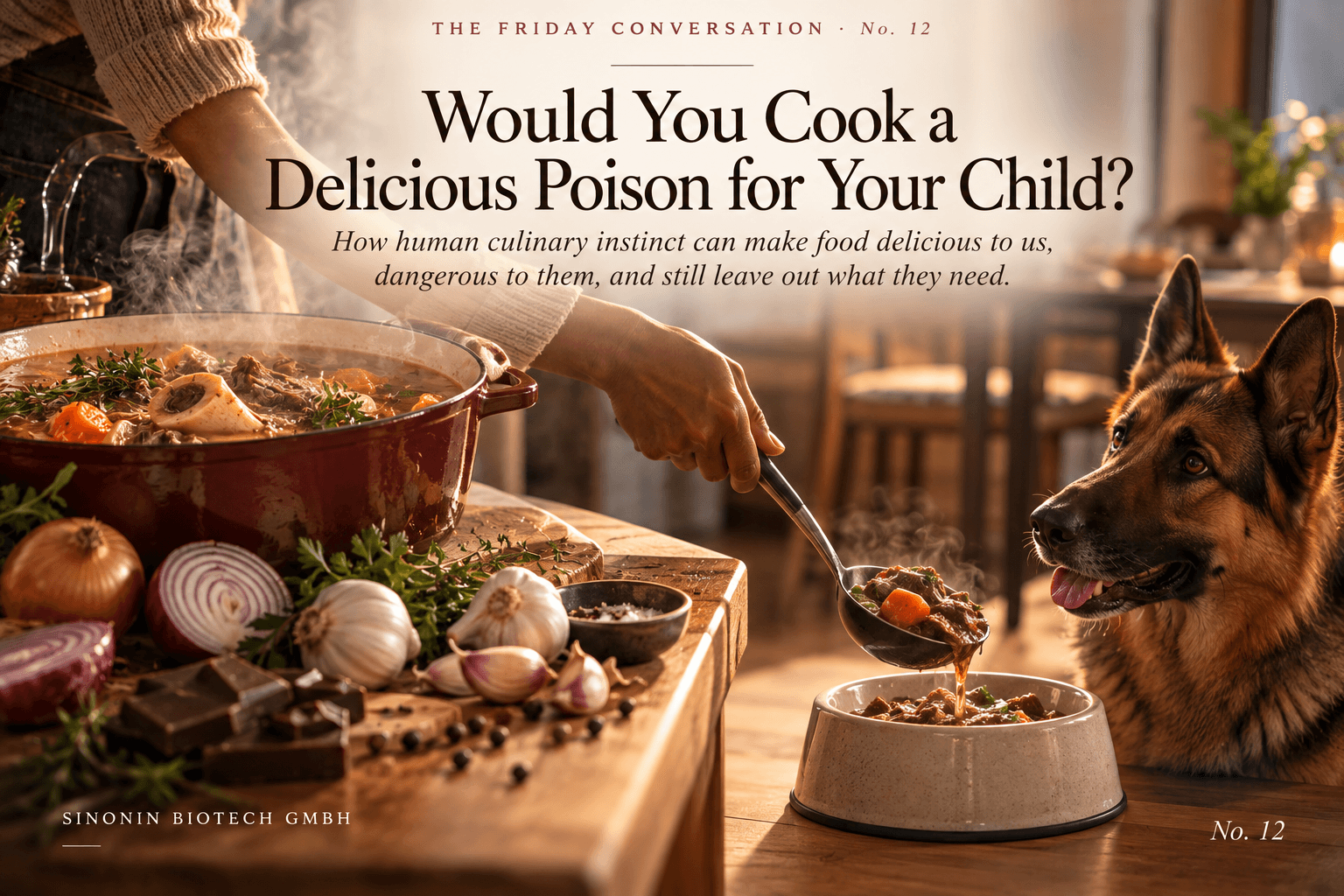
On a recent visit to a home in the countryside, the owner told me, with real pride, how they cook for their German Shepherds. They go to the butcher for bones, bring them home, add a generous helping of onions, and simmer the pot overnight until the kitchen fills with the smell of it. A broth made slowly, by hand, out of love, for animals treated as family. It was described to me the way a good cook describes any dish they are proud of, and I did not have the heart, in that moment, to say what I knew.
Because that broth, made with such care, is close to the most efficient way I can think of to poison a dog.
Not through any carelessness. Quite the opposite. Every step in it is a step a thoughtful human cook would take. The long simmer that deepens a stock. The onions that give a broth its savoury base. The patience of leaving it overnight. These are the instincts of someone who knows how to make food taste good, applied with devotion to an animal they adore. The trouble is that the animal is not a human, and some of the very things a human cook reaches for to make that broth more delicious can make it dangerous to the dog it was lovingly made for.
And it is not only a rural habit, or an old one. In the cities, a growing number of devoted owners distrust the commercial food on the shelf, suspect the factory and its processing of hiding something toxic, and resolve to feed their pets the way they feed the rest of the family, with real food, cooked at home, by their own hands. The impulse is a good one, and the suspicion is not always wrong. But a person who has decided that the factory’s food is poison, and who then seasons the home-cooked alternative the way they would season their own dinner, can end up doing the very thing they were trying to avoid, because the human kitchen contains perfectly ordinary ingredients that another species may not tolerate.
So the question this Conversation turns on is an uncomfortable one for anyone who loves an animal enough to cook for it. When we make our pets a meal with our own hands, whose palate are we actually cooking for, and are we sure the thing that would delight us is not quietly harming them?
❦
Movement I · THE UNWRITTEN ART
Before we go near the harm, it is worth pausing on the skill, because the skill is real and almost everyone has it.
There is an art to making food pleasurable, and the remarkable thing about it is how little of it is taught. A person who has never read a recipe or studied a cuisine still knows, somehow, the moves that turn mere sustenance into a meal worth sitting down for. A pinch of salt to wake a dish up. A splash of soy, or a little of the savoury powder that deepens everything it touches. Onions and garlic softened in fat until the whole house smells of dinner and the appetite arrives before the plate does. Something acid to brighten, something sweet to round, a glass of wine beside it to loosen the evening, and a small bitter coffee at the end to settle the stomach and sharpen the mind. None of this is written down anywhere the cook consulted. It is carried in the hands and the nose, passed from kitchen to kitchen, obeyed by the unschooled as faithfully as by the chef.
The art of making food delicious is the one cookery almost everyone knows without being taught.
And it works, because it is tuned, over a very long time, to the human animal. Our appetite rewards salt because our ancestors had to seek sodium out, and rewards sweetness because sweetness meant ripe fruit and quick energy; those are ancient biology. Layered over them is a great deal of culture, the acquired human loves of the sharp smell of alliums, of a little wine with dinner, of a bitter coffee at the end, tastes we are not born craving but learn, in our own kitchens, to find delicious. Some of the cook’s instincts are biology, some are culture, and most are now so familiar that the cook no longer needs to know which is which. When we say a dish is delicious, we mean it has satisfied that whole inherited and acquired human apparatus at once. The home cook is, in this sense, a kind of intuitive scientist of the human palate, running an experiment they never designed and getting it right by feel.
So when that same cook decides to make something for the animal at their feet, they do the natural thing. They reach for the only art they have. They cook for the pet the way they cook for the family, with the same hands, the same instincts, the same levers, because those levers have never once failed them at a human table. Why would the dog be any different? It has a mouth, it gets hungry, it clearly enjoys its food. The assumption is so quiet and so reasonable that it is barely an assumption at all. It is simply what everyone knows. And it is exactly here, in the gentlest and most loving transfer of a skill from one table to another, that the whole thing goes wrong. Because the levers the cook is pulling were built for a different animal. What if the instrument that has never failed at the human table is the wrong instrument entirely, the moment the eater is not human?
❦
Movement II · THE SAME GESTURE, A DIFFERENT BODY
Return, then, to the broth, and watch what each loving step actually does once the eater is a dog.
The onions come first, and they are the gravest of it. Onions, like garlic, leeks and chives, belong to a family of plants that carry sulfur compounds harmless to us and dangerous to dogs and cats. Inside the animal those compounds become reactive agents that attack the red blood cells, damaging them until the body destroys them faster than it can make them, a condition called haemolytic anaemia. The cook who adds onions for savour is, without the faintest idea of it, adding the most obvious toxic hazard in the pot. And three details turn an unlucky ingredient into something closer to a trap. The first is that cooking does not make the onion safe; raw, cooked and concentrated forms can all cause the injury, so the long simmer that a cook trusts to improve a dish does nothing to remove the hazard. The second is that the harm can also follow repeated smaller exposures, which is exactly the pattern a broth made in a large pot and fed across several days can create. And the third is the cruelest. The damage is delayed, often by days, so the dog does not fall ill at the bowl where the cause would be obvious. It sickens later, by which time the broth is long forgotten, and the one person most likely to connect the two, the devoted cook, is the last to suspect the thing they made with love.
The onion that deepens the broth for us can turn the same loving meal into a hazard for the dog.
And the onion is not alone. Walk back along the human cook’s toolkit and an uncomfortable pattern appears: some of the most ordinary ingredients in our kitchens cross the species boundary very differently from the way they sit with us. The square of dark chocolate we might think a kind treat carries theobromine, a stimulant we clear easily and dogs clear only slowly, so it lingers and builds and can, in sufficient amount, disturb the heart and the nervous system. There is a small biological irony here: cats are susceptible too, but their lack of sweet taste and their different, more discriminating feeding behaviour make the dog by far the more frequent chocolate patient, which is the argument of the last Conversation surfacing again at the family table. A few grapes or raisins, innocent at the human table, can cause acute kidney injury in susceptible dogs; tartaric acid is now a leading explanation, but individual risk remains unpredictable enough that an exposure should never be treated casually. And the grape is worth lingering on, because it is rarely cooked into anything. It is shared. Picture the family picnic, the parents idly eating grapes while the children run loose across the grass, and the dog that stayed, patient and good, at the edge of the blanket. Someone holds out a grape, a small reward for its steadiness, a way of saying you are one of us, have some of what we are having. That gesture is the purest expression of the whole impulse this essay is about, the animal folded into the family and offered the family’s food, and it falls on a fruit whose risk to an individual dog remains disturbingly unpredictable.
The grape held out to the dog is not a meal. It is a welcome, offered on a fruit whose risk no one can predict.
None of these is an exotic poison kept in a locked cabinet. They are the ordinary furniture of a human kitchen, the things a good cook reaches for precisely because they make food taste of care.
So the pattern is not that careless owners harm pets while careful ones do not. It is stranger and more interesting than that. Culinary competence does not automatically transfer across species. The skills that make a person good at feeding humans, the instinct for seasoning, for depth, for the touches that signal care, are instincts about the human body and the human palate, and they carry no built-in knowledge of which of their pleasures are, to another animal, hazards.
Skill at the human table is real. It simply does not know which of its pleasures cross the species line.
A person can be an excellent cook and know nothing of the fact that onions injure a dog’s blood, not through carelessness, but because nothing in the art of human cooking was ever required to teach them. Which leaves a genuinely unsettling question for anyone who has ever cooked for an animal out of love. If the competence we trust at the human table carries no knowledge of the animal’s body, then what, exactly, has our skill been skill at?
❦
Movement III · THE PROJECTION
Step back from the stove, because the mistake in the broth is not really a mistake about onions. It is a mistake about the animal, and it is the same mistake the whole of this series has been circling, arriving now in the most intimate place it could.
A recent Conversation argued that a cat is not a small dog, that we had quietly treated feline palatability as the canine kind with the volume turned down, and that the two animals in fact taste, smell and judge the world through different biology. The home cook makes the identical error, one rung further out. The pet is not a small human. The dog at the table is not a person with fur and a shorter vocabulary, running the same palate on the same chemistry and simply unable to ask for the salt. It is a different animal, with a different body, for which our food is not a smaller portion of the same thing but, in places, a different and dangerous substance. We shrank the human down, kept our own palate, and handed the result across the table as though love could make up the difference in biology. It cannot. Biology does not grade on intention.
We decided the pet was family. We forgot that family does not mean the same species.
And this is where the thread that has run through every one of these Conversations pulls tight. Palatability, we have said again and again, does not live in the food. It is not a property sealed inside a recipe, portable to whatever eats it. It is a response, assembled in a particular animal, by a particular biology, out of signals that animal’s own body decides how to read. The formulator who forgot this built foods tuned to the wrong species. The clinician who forgot it misread the sick animal at the bowl. And the home cook who forgets it does something at once more loving and more dangerous than either, because the home cook is not running a trial or filling a bowl on a schedule. The home cook is expressing devotion, with their own hands, at their own table, and has every reason to believe that devotion is enough. It is the purest version of the error, and the one with the sharpest edge, because here the gap between what we intend and what the animal receives is not a matter of market share or clinical outcome. It is a matter of whether the animal is harmed by the very act meant to cherish it.
There is a hard thing to say here, and it is not a defence of anyone’s commercial interest, only an observation about knowledge. Commercial petfood is not safe merely because it came from a factory, just as home-cooked food is not unsafe merely because it came from a kitchen. The difference that matters here is narrower and quieter than the argument between the two usually allows. Formulated petfood can draw on species-specific nutritional and toxicological knowledge that the ordinary human cook was never expected to possess, the knowledge that onions injure a dog’s blood, that a cat’s body has requirements a dog’s does not, that there are things our food contains which theirs must not. That knowledge is not love, and it is no substitute for it. But when we reject formulation simply because it is formulation, we risk throwing away not only the processing we distrust but knowledge we did not know was there. And there is a second blindness beneath the first, quieter and in its way larger. Everything so far has been about what the loving cook puts in, the onion, the chocolate, the grape. But a home-cooked bowl can contain not one of those, not a single recognised toxin, and still fail the animal, because the danger in the home kitchen is not only what we add. It is also what love cannot tell us is missing. A dog or a cat needs a particular balance of calcium against phosphorus, a set of trace minerals, the right fats, certain vitamins, and, for the cat, enough dietary taurine, because its own synthesis cannot meet its requirements. None of these announces its absence. A broth can smell wonderful, be eaten with joy, contain nothing harmful, and quietly starve the animal of something its body cannot do without, over months, invisibly. The human palate was never an instrument for detecting a missing trace mineral. It was built to enjoy a meal, not to audit one.
So the question this movement leaves is not whether to cook for the animals we love. It is whether love, by itself, has ever been enough to feed them safely, or whether it has always needed something it does not contain.
❦
Movement IV · FEEDING WHAT YOU LOVE
Would you cook a delicious poison for your child?
The question sounds absurd, even cruel, and that is the point of asking it, because the people this essay is about would answer no without a breath of hesitation, and yet some of them, without knowing it, may be putting into a beloved animal’s bowl ingredients they would be horrified to recognise as dangerous to that species. They have decided, and rightly, that the animal in their home is family, a child in all the ways that matter to the heart. And then they cook for that child the way they cook for themselves, and prepare the bowl according to the same culinary instincts they use for their own plates, and set down, with love, a dish that is delicious to them and may be dangerous to the one eating it. The language of the fur baby and the family member turns out to carry a trap inside it, because if the pet truly is a child, then the loving broth is not a sweet indulgence. It is a delicious poison, cooked for a child, by a devoted parent who would be horrified to learn what they had made.
If the pet is truly family, then the loving broth is a delicious poison cooked for a child.
None of which is an argument against cooking for the animals we love, and it would be a poor reading of this essay to walk away from the stove in guilt. The impulse to feed your own with your own hands is one of the oldest and best things we do, and it deserves better than to be abandoned out of fear. What it does not deserve is to be trusted blindly. The love is not the problem. The love is the whole reason to get this right. The problem is only ever the quiet assumption that rides along beside the love, the belief that a creature we hold as family must therefore share our palate, our chemistry, our idea of what a good meal is. Strip that assumption out and the devotion remains, intact and admirable, needing only to be pointed at the right animal.
And that is a solvable thing, though not by this essay, which can diagnose the mistake but has no business pretending to be a recipe. The knowledge the home cook lacks exists. It is held by veterinarians and appropriately qualified veterinary nutrition specialists, by the people whose work is precisely to know which of the kitchen’s pleasures are hazards and how a home-cooked diet can be made complete and safe rather than merely heartfelt. A person who wants to cook for their pet can learn what a cat is, what a dog is, what their bodies can and cannot do with the things we eat, and can build a table that honours both the love and the biology. The cooking need not stop. It only needs to start from the animal rather than from us.
Because the whole of this long conversation comes down, in the end, to a single quiet correction. We have spent these essays saying that palatability lives not in the food but in the animal that receives it, and nowhere is that truer, or more tender, than at the family table, where the food is made of love and the animal is the one we would least wish to harm. The table set with love is a good table. It only has to be set, at last, for the animal that is actually going to eat from it.
References
1. Cortinovis, C. & Caloni, F. (2016). Household food items toxic to dogs and cats. Frontiers in Veterinary Science 3:26. doi:10.3389/fvets.2016.00026
2. Salgado, B.S., Monteiro, L.N. & Rocha, N.S. (2011). Allium species poisoning in dogs and cats. Journal of Venomous Animals and Toxins including Tropical Diseases 17(1):4-11. doi:10.1590/S1678-91992011000100002
3. Eubig, P.A., Brady, M.S., Gwaltney-Brant, S.M., Khan, S.A., Mazzaferro, E.M. & Morrow, C.M.K. (2005). Acute renal failure in dogs after the ingestion of grapes or raisins: a retrospective evaluation of 43 dogs (1992-2002). Journal of Veterinary Internal Medicine 19(5):663-674. doi:10.1111/j.1939-1676.2005.tb02744.x
4. Wegenast, C.A., Meadows, I.D., Anderson, R.E., Southard, T., González Barrientos, C.R. & Wismer, T.A. (2022). Acute kidney injury in dogs following ingestion of cream of tartar and tamarinds and the connection to tartaric acid as the proposed toxic principle in grapes and raisins. Journal of Veterinary Emergency and Critical Care 32(6):812-816. doi:10.1111/vec.13234
5. Stockman, J., Fascetti, A.J., Kass, P.H. & Larsen, J.A. (2013). Evaluation of recipes of home-prepared maintenance diets for dogs. Journal of the American Veterinary Medical Association 242(11):1500-1505. doi:10.2460/javma.242.11.1500
6. Pion, P.D., Kittleson, M.D., Rogers, Q.R. & Morris, J.G. (1987). Myocardial failure in cats associated with low plasma taurine: a reversible cardiomyopathy. Science 237(4816):764-768. doi:10.1126/science.3616607
7. van der Vyver, Y., Paul, A., Blecker, C. & Danthine, S. (2026). Gaps and controversies in feline food palatability. Animals 16(17):2721. doi:10.3390/ani16172721
❦
About the Author
Dr. rer. nat. habil. Dr. Seronei Chelulei Cheison is the founder and Chief Executive Officer of Sinonin Biotech GmbH, where he works with petfood companies on palatant sourcing strategies, the innovation of palatability enhancers, and the design of palatability assessment. A trained food enzymologist, he led alternative protein and palatant development at Mars Petcare before founding Sinonin, and his research on protein chemistry spans two decades, a doctorate from Jiangnan University, and a habilitation from the Technical University of Munich.
❦
Sinonin Biotech GmbH is a partner in the ZEST project (Grant Agreement No. 101157382) and the PROSCALE project (Grant Agreement No. 101288362), both funded by the Circular Bio-based Europe Joint Undertaking (CBE JU) under the European Union’s Horizon Europe research and innovation programme. Views and opinions expressed are those of the author only and do not necessarily reflect those of the European Union or CBE JU. Neither the European Union nor the granting authority can be held responsible for them.
- Cat Nutrition
- Chocolate Toxicity
- Dog Nutrition
- Grape Toxicity
- Home-Cooked Pet Food
- Onion Toxicity
- petfood palatability
- Taurine
- The Friday Conversation
- Veterinary Nutrition