
Palatability | November 12, 2026
The Sixth Ingredient: How Packaging Shapes Palatability
The Sixth Ingredient. We validate the recipe, we validate the cook and we validate the bag, each to a high standard, in separate rooms, and the animal lives in none of them. On the sterilising heat that makes a wet food’s flavour and costs it, the aroma the package quietly takes, the faults it adds, and why a pack
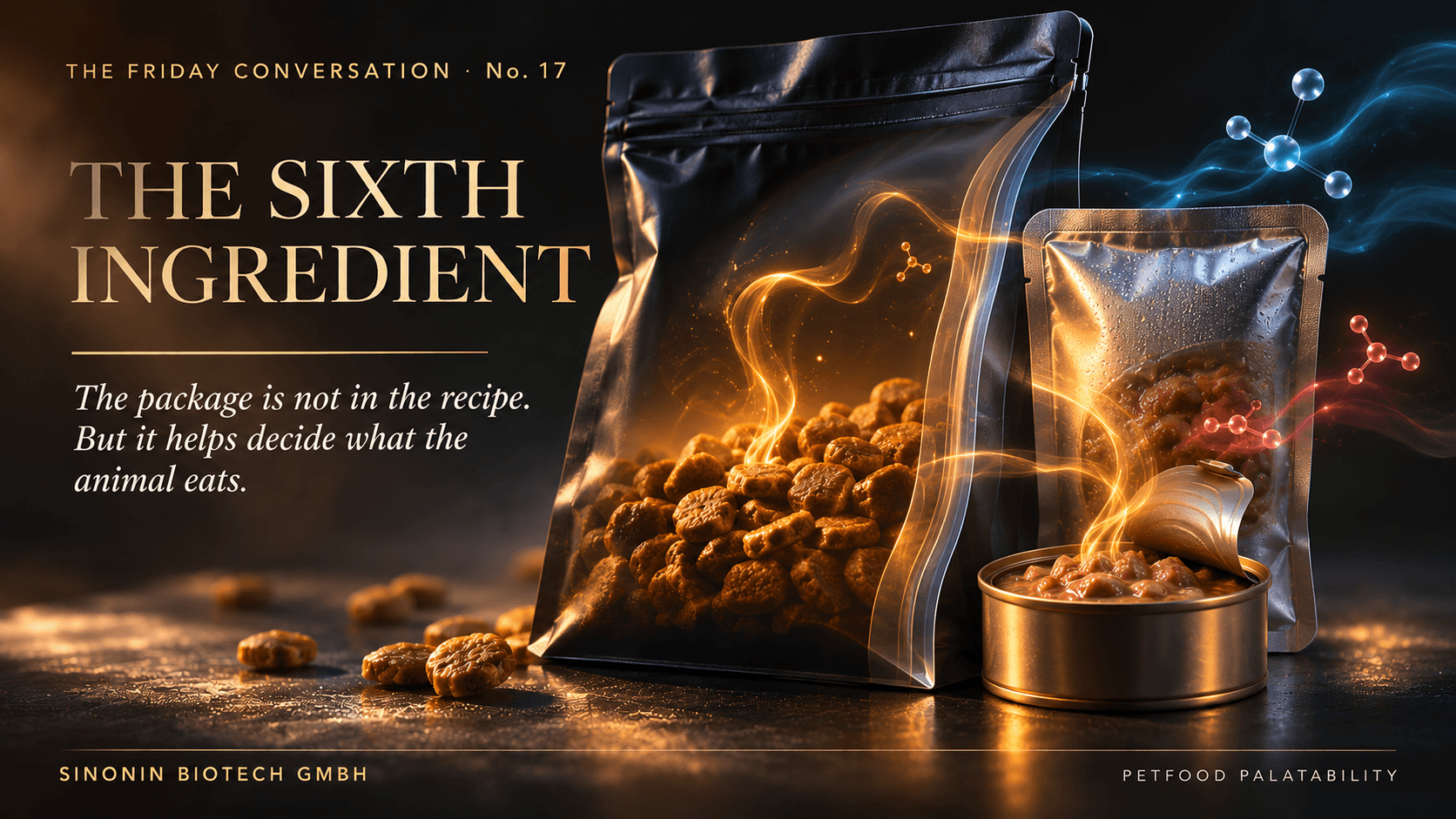
How Packaging Shapes Petfood Palatability
The Sixth Ingredient. We validate the recipe, we validate the cook and we validate the bag, each to a high standard, in separate rooms, and the animal lives in none of them. On the sterilising heat that makes a wet food’s flavour and costs it, the aroma the package quietly takes, the faults it adds, and why a pack
Movement I · THE SIXTH INGREDIENT
Is the food you tested the food the animal eats? Picture two bags of the same dry cat food, side by side on a shelf. Same formulation, same production batch, the same palatant applied at the same rate over the same fat coating, the same moisture the day they left the line. One is a multilayer laminate with a high barrier to oxygen and moisture. The other is a simpler, more recyclable structure. Both are properly sealed, both meet their specifications, both carry the same name and the same declaration. Six months later, someone opens them. Are they still the same food?
Nutritionally, perhaps. Legally, perhaps. But a cat does not eat the nutrition panel, and the sensory answer is less obvious, and more interesting, than we usually allow.
We have become remarkably good at formulating food, and remarkably good at packaging it. Both are mature sciences. The packaging engineer measures oxygen transmission and water-vapour barrier and seal integrity, and runs the shelf-life trials; the formulator measures protein and fat and fibre, optimises the cook, and tests whether the animal will accept the result. What rarely happens is that the two are validated as one thing, the food in its package, as the animal finally meets it. The disciplines are sophisticated. They are also, for the most part, practised in separate rooms.
And food does not stop being chemical matter when the filling line seals it. The fats are still oxidisable. The volatiles are still partitioning between phases. Water can still move, within the food and across an imperfect barrier. The packaging can take compounds out of its contents, and compounds can travel the other way. None of that makes a package dangerous, and modern packaging is engineered precisely to hold these processes in check. But it means something the development sheet rarely admits.
The package is not an ingredient in the formulation. It is nevertheless part of the food that gets eaten.
Call it, loosely, a sixth ingredient: the one that never appears on the label, that is tested for its barrier and its shelf life but rarely for its taste, and almost never as the animal meets it, from a bag opened and reclosed for a month. And here is the thread this Conversation will follow, borrowed from No. 16. We said, of alternative proteins, that a food can fail two opposite ways, by lacking the signal the animal wants and by carrying one it does not. The package can push a food either way, and not only on the shelf. For wet food it begins at the moment of manufacture, because the food is cooked inside the sealed pack; for dry food it runs on through every week in the warehouse and the cupboard. The package can take the signal away, and it can add a fault of its own. It is capable of the same two failures as the formula, and we rarely put it in front of the one judge who would notice, under the conditions the animal actually eats.
❦
Movement II · THE PACKAGE THAT COOKS THE FOOD
When is a package not a container? When it is the pot the food was cooked in. For wet pet food, the can, the pouch and the tray are exactly that. The food is filled, the pack is sealed, and only then is the whole of it heated, hard and for a long time, under a validated thermal process, until it reaches what the trade calls commercial sterility: not every last microbe killed, but enough that the unopened pack stays safe and stable on a shelf for years without refrigeration. The cook happens inside the closed package, with the food already in its final home. So for a can of cat food the package is not holding the finished product. It is the vessel in which the product was finished.
That cook answers to a governing requirement, and the requirement is safety. The schedule must deliver enough accumulated lethality at the slowest-heating point in the pack, wherever the product and the process put it and not always the geometric centre, to destroy the organisms that could make the food dangerous or let it spoil; that point is found by heat-penetration study, not assumed. Other things shape the schedule too, the equipment, the integrity of the seal, the quality the product must keep, but safety is the floor none of them may breach, and flavour is not on the list at all. The lethality even has a name in the trade, the F-value, an equivalent thermal lethality rather than a fixed target; what counts as enough depends on the reference temperature, the organisms in view and the validated process, not on a single number any two foods must share. It is a magnificent piece of engineering. It is simply not pointed at taste.
The retort schedule is written for the organism we must kill, not for the flavour we would like to keep.
Here the geometry of the package quietly takes a hand. Where a food is dense and pasty enough to heat mainly by conduction, heat crawls in slowly from the walls, and the slowest point lags well behind the edge; to bring it up to a safe value, everything around it is held hotter for longer than it needs, and over-cooks while the middle catches up. A thinner pack, a pouch or a shallow tray, can offer the heat a shorter path to that slowest point, and cook the food more evenly and more quickly. A tall can offers a longer path, and often pays for it in over-processing. I say can and often, not must, because the real heat penetration also turns on fill thickness, viscosity, how the pack sits, whether the retort agitates it, and how hot the food started. Geometry shifts the odds; it does not settle them. The format was chosen for filling, distribution and cost. It also helped set the heat-penetration profile, the processing time required, and the thermal history the food actually lived through.
The contrast with milk makes the point, because dairy shows what becomes possible when microbial inactivation and quality loss fall away at different rates with temperature. For suitable products a very high temperature applied for a short time can deliver the required microbial inactivation while sparing much of the quality. The principle runs through high-temperature, short-time processing and, at more severe conditions, through the ultra-high-temperature sterilisation of milk, though how far the two can be pulled apart still depends on the organism, the reaction and the food itself. And it leans on a freedom wet food lacks: in aseptic processing the product is sterilised as it flows and then filled into an already-sterile pack, rather than being sterilised inside it. A viscous meat emulsion sealed in its can before it is cooked has no such escape; its heat penetration is set by conduction and by the shape of the pack, and the hot-and-brief route mostly closes. Wet pet food lives nearer the slow, hot, long end, whether or not that is where its flavour would have chosen to live.
What happens to the food along the way is the part the safety requirement was never asked about, and it is the argument of No. 14 at its most extreme. The same heat that sterilises is the heat that browns, and the cook is where much of the meaty, roasted, savoury character of wet food is actually generated, the Maillard and related reactions that give a sterilised pâté a smell a cat will cross a room for. So the retort is not merely a tax on flavour. It is, in part, the maker of it. But the very same heat also raises cooked and sulphurous off-notes, drives the oxidation of fragile fats, and quietly costs the food some of its most heat-sensitive nutrients. The process that creates the signal creates the fault as well, in the same minutes, under a schedule set for neither.
Which returns us to the harder question. The thermal process can be optimised, as dairy proves. But optimised for what? For the recipe cooked as if in open air, or for the recipe as it actually sits, in that pack, of that shape, undergoing the reactions that this food in this container will undergo, desirable and otherwise? Those are not the same target. The task is not merely to settle on a safe thermal process; it is to understand how that process, meeting this recipe inside this package, shapes the food the animal is finally handed.
❦
Movement III · WHAT THE SEALED PACKAGE TAKES, AND WHAT IT ADDS
Once the pack is sealed and sitting, is it doing nothing? It looks inert. It is not. A sealed package is in slow chemical conversation with the food inside it, and the conversation runs both ways. It can take something out of the food, and it can put something in. These are the two failures of No. 16 again, now committed by the container rather than by the recipe.
Take the quieter direction first, the one discussed almost nowhere outside packaging and flavour science: aroma scalping. A volatile molecule that was in the food, or in the headspace around it, can partition into the packaging material and be held there. That is the package taking the aroma up, and it is worth separating from its neighbours. It is not the molecule passing all the way through the wall and escaping, which is permeation; nor the aroma settling back into the food’s own fat; nor the molecule reacting into something else. It is the wall offering itself as another phase for the smell to dissolve into.
It is tempting to picture this as the food merely growing fainter, losing a little of everything evenly. That is not the interesting case, and often not the real one. The compounds that make an aroma do not contribute equally; some sit at vanishingly low concentrations and carry much of the character. If the material takes up some of them more readily than others, the food can keep most of its total volatile content and still lose the few compounds that mattered most. The balance shifts, and the aroma that remains is not a weaker version of the first. It is a different one. Sorption, strictly, is only the physical taking-up; it earns the uglier name scalping when what it removes is aroma the food needed, and not every molecule that enters the wall was one the animal would have missed. The question, as in No. 9, is not how much aroma a laboratory can still extract. It is how much is still available, at the bowl, to reach the animal.
Aroma is not merely created. It must also survive.
Now the other direction, what the package adds, or lets in. Some of the addition is the package’s own chemistry. A packaging structure is not always one perfectly inert film, and under the right conditions a little of something, from an additive, a residue, an adhesive or an ink, can migrate from the wall into the food. The discipline matters here, because the presence of a compound in a material does not prove it migrates, and migration does not prove an off-taste, any more than it proves a hazard. But where it does cross over and carry a flavour, the result is a taint the animal never agreed to, laid onto the food by its container.
Most of what the package lets in, though, comes through the barrier rather than out of it. Oxygen is the first. A food full of unsaturated fat will oxidise given air and time, and a barrier that passes oxygen, or a headspace that trapped some at filling, feeds that slow change. Oxidation can turn the fat that carried the signal, the subject of No. 4, into a source of the opposite: the stale, the cardboard, the rancid. The chemistry runs in a known direction, and that much is not in doubt. Whether the animal minds, and from what point, is a separate question, and not one an oxidation number can settle on its own, the more so since those markers themselves rise and fall as the reaction proceeds.
Moisture is the second, and it brings No. 13 back by another door. A barrier that passes water vapour lets the food drift toward the humidity around it, and here two properties that are easy to confuse pull apart. Moisture content is how much water is present; water activity is something different, its availability. Neither acts alone, but together with the food’s structure, composition and temperature they bear on how a kibble fractures, how its coating behaves, and how readily it gives up its aroma. A piece that has taken on a little moisture is not merely damper; it can behave like a different piece in the mouth and at the nose. Whether that helps or harms acceptance is, again, the animal’s question to answer, not the hygrometer’s.
A barrier is not a promise that chemistry has stopped. It is an attempt to control how it continues.
Three doors, then, and worth keeping apart, because the key to one does not always open another. The aroma that soaks into the wall leaves by sorption; the taint that comes the other way arrives by migration; the oxygen and the water cross by permeation. Improving a film’s oxygen barrier need not touch its scalping, because stopping oxygen and holding volatiles are different properties of the material, and the one that excels at the first is not always the one that excels at the second, though a change made for the one can sometimes shift the other. Even standing still on a shelf, the package is not one problem. It is several, wearing one wrapper.
❦
Movement IV · THE BAG SIZED FOR THE SHELF, NOT THE CAT
What happens the moment the bag is opened? Until then, the protections we have described are doing their work; after it, the system changes. The seal is broken, the headspace trades with room air, and the food begins a new storage history, one shaped by how often the pack is opened, how well it is reclosed, and how long its contents sit inside before they are eaten. A good reclosure slows that history; a torn bag or a bent clip hurries it. But the sealed state is over, and a question the specification sheet never asks has started its clock: how long will this package stay open?
That answer is set by a decision almost no one treats as a palatability decision: the size of the pack. A bag or a can is sized for the shelf and the checkout, for the economics of filling and of buying, and rarely for how fast one small animal actually empties it. A large bag bought for a single cat is opened once and then returned to, a little at a time, for weeks. By the time the last portion reaches the bowl, it has spent far longer in a repeatedly opened package than the first portion did. Its formulation has not changed, and it came off the line in the same batch; its age and its exposure have. The food the cat eats in week four is three weeks older than the food it ate in week one, from that very same batch, and it has spent those three weeks in a pack opened and reclosed again and again.
The bag was sized for the shelf. The animal eats on its own clock.
Wet food brings the question into the kitchen. A cat may eat only part of a can or a tray, and the rest is covered, refrigerated, and offered again. By the second serving its temperature, its headspace, its surface and the way it releases its volatiles may all differ from the freshly opened product. Does the cat notice? Does it care? And if it turns away, was the fault in the recipe, the storage, the serving temperature, or something else entirely? A trial run on the fresh product cannot answer those questions on its own, and yet the fresh product is almost always what gets tested.
The market has an answer to some of this, and it is worth reading carefully rather than claiming too much from it. The single-serve pouch and the small tray seal each portion until the meal, so nothing is left opened to sit and change between servings. They do not stop the unopened pack from ageing on the shelf, and they do not settle temperature, product age or how the food is served; what they remove is one large source of variation, the opened pack returned to again and again. But it is a clean case of the one thing this movement is about: that the size and the format of a package, quite apart from its material, shape what the animal finally meets. The format was always a lever, whoever reached for it, and for whatever mix of reasons.
And it brings the oldest problem in this series back from a new direction. We may establish a food’s palatability on a freshly opened sample, under carefully controlled conditions, and then let that number stand for a product the household will store, open, reclose and serve across weeks. Some programmes do test aged product, and shelf-life panels exist; the harder question is whether any of it is run the way the pack is actually used. We measured the food under one controlled set of conditions, and let that result stand for all the others.
❦
Movement V · THE ANIMAL EATS THE SYSTEM
So, after six months, are the two foods still the same? Suppose the analysis finds real differences between them, in a few volatiles, in an oxidation marker, in moisture. Have we shown that one is more palatable than the other? We have not. We have shown that the two changed differently under the conditions we watched. To show a difference the animal cares about, we need the animal, in a study built to ask it, and even then the reading is not simple. A preference might turn on the altered aroma, or the oxidised fat, or the texture, or the moisture, or several at once, and a two-bowl score will not tell us which. It is the lesson of No. 9 and No. 16 arriving together: the number tells us the animal responded differently, not why.
And there is a sharper question underneath the obvious one. When we worry that a package might change the food, are we asking about the effect of the packaging material, the effect of the geometry and the cook it imposed, or the effect of the storage history it creates once it is opened? They are three different studies. The first holds everything else fixed and varies the material: identical batches in different films, one defined storage, the animal asked at matched ages. The second varies the shape, and here is the trap, because changing the geometry usually changes the thermal history with it, so a study that means to isolate the pack’s form has to measure the cook it caused and, as far as it can, hold that cook constant or account for it. The third holds the food and the pack fixed and varies the handling: the opening and reclosing and the weeks in a cupboard, the real life of a pack in a house. A package can pass one and fail another. These questions are not always addressed within one validation programme, and answering one does not answer the others. The animal, meanwhile, lives in all three at once.
Which is the real gap, and it is not that packaging is a neglected science; it is a sophisticated one, and so is thermal processing, and so is formulation. The gap is that they are rarely validated as a single system, the recipe and the cook and the package and the weeks of real use, under the conditions a household actually imposes. We prove the barrier, we prove the recipe, and we prove the sterilising cook, each to a high standard, in separate rooms. The animal does not live in any of them.
We formulate the food and we engineer the package, but the animal eats the system.
Return, then, to the two bags opened after six months. Does the animal’s verdict now match the one it gave on day 14, in the trial that cleared the food for sale? And if it has moved, can we assign the change to the food ageing on its own, to what the container did to it, or to the two so entangled that no study we ran can part them? The animal will not say. It never separated the recipe from the cook, the food from its package, or the first day from the sixth month; it meets the result of all of them and renders one verdict. Working out what that verdict was about is our job. Perhaps it is time we tested the system the animal actually encounters.
References
1. Awuah, G.B., Ramaswamy, H.S. & Economides, A. (2007). Thermal processing and quality: principles and overview. Chemical Engineering and Processing: Process Intensification 46(6):584-602. doi:10.1016/j.cep.2006.08.004
2. Mottram, D.S. (1998). Flavour formation in meat and meat products: a review. Food Chemistry 62(4):415-424. doi:10.1016/S0308-8146(98)00076-4
3. Watson, P.E., Thomas, D.G., Bermingham, E.N., Schreurs, N.M. & Parker, M.E. (2023). Drivers of palatability for cats and dogs: what it means for pet food development. Animals 13(7):1134. doi:10.3390/ani13071134
4. Sajilata, M.G., Savitha, K., Singhal, R.S. & Kanetkar, V.R. (2007). Scalping of flavors in packaged foods. Comprehensive Reviews in Food Science and Food Safety 6(1):17-35. doi:10.1111/j.1541-4337.2007.00014.x
5. Wrona, M. & Nerin, C. (2020). Analytical approaches for analysis of safety of modern food packaging: a review. Molecules 25(3):752. doi:10.3390/molecules25030752
6. Roudaut, G., Dacremont, C., Valles Pamies, B., Colas, B. & Le Meste, M. (2002). Crispness: a critical review on sensory and material science approaches. Trends in Food Science & Technology 13(6-7):217-227. doi:10.1016/S0924-2244(02)00139-5
7. Eyre, R., Trehiou, M., Marshall, E., Carvell-Miller, L., Goyon, A. & McGrane, S. (2022). Aging cats prefer warm food. Journal of Veterinary Behavior 47:86-92. doi:10.1016/j.jveb.2021.09.006
❦
About the Author
Dr. rer. nat. habil. Dr. Seronei Chelulei Cheison is the founder and Chief Executive Officer of Sinonin Biotech GmbH, where he works with petfood companies on palatant sourcing strategies, the innovation of palatability enhancers, and the design of palatability assessment. A trained food enzymologist, he led alternative protein and palatant development at Mars Petcare before founding Sinonin, and his research on protein chemistry spans two decades, a doctorate from Jiangnan University, and a habilitation from the Technical University of Munich.
❦
Sinonin Biotech GmbH is a partner in the ZEST project (Grant Agreement No. 101157382) and the PROSCALE project (Grant Agreement No. 101288362), both funded by the Circular Bio-based Europe Joint Undertaking (CBE JU) under the European Union’s Horizon Europe research and innovation programme. Views and opinions expressed are those of the author only and do not necessarily reflect those of the European Union or CBE JU. Neither the European Union nor the granting authority can be held responsible for them.
- Aroma Scalping
- Cat Nutrition
- Dog Nutrition
- Packaging
- pet food formulation
- petfood palatability
- Retort Processing
- Shelf Life
- The Friday Conversation
- Thermal Processing