
Palatability | October 29, 2026
How Carbohydrate Shapes Petfood Palatability
**The Carbohydrate Paradox.** The largest ingredient in many a bowl is one no dog, cat or person tastes as itself. So what, exactly, does an animal prefer when it prefers the food? On the carbohydrate that may never be tasted as carbohydrate, and the food that would not be the same without it.
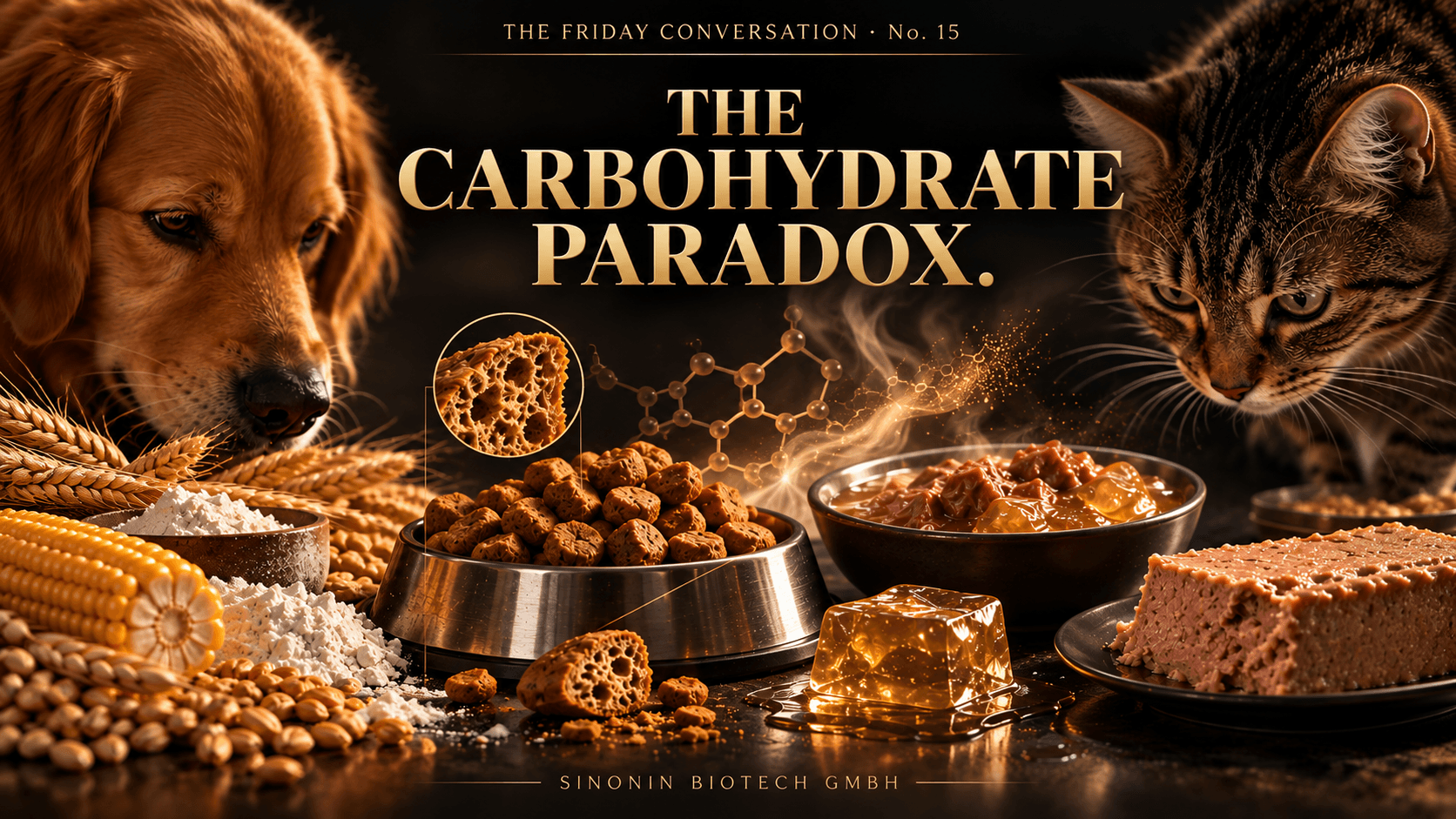
Movement I · THE CARBOHYDRATE NOBODY TASTED
What is an obligate carnivore really eating when it works through a bowl of dry food? Tip the measure in, and much of what holds that kibble together as a hard, dry, pourable object is starch, the carbohydrate that gives the piece its body and lets it leave the machine a solid thing. The cat may eat it readily. But does it taste it? Not as anything much. Purified starch carries little of the sweetness, sourness, bitterness or savour the tongue is tuned to, and it does not announce itself to the mouth the way a sugar does. We can build a food around it, an animal may come to prefer that food, and the starch itself goes all but unremarked by the palate that eats it.
That is the paradox worth opening on, and the obligate carnivore states it most sharply. Here is an animal whose evolutionary brief was meat, eating willingly a food whose very architecture may rest on the one macronutrient it has least instinct to seek, and finding little to taste in it. Starch is the bowl’s silent partner, the biggest thing in it that the tongue barely registers. So how can it have anything to do with whether the animal wants to eat?
Starch is the bowl’s silent partner, the biggest thing in it that the tongue barely registers.
The dog meets the same bowl as a different animal. It can register a sweetness the cat cannot, and it tends to handle cooked starch more readily, though how readily depends on how the starch was processed and on the dog itself. So its relationship with carbohydrate, in the mouth and after, is not the cat’s. But the sweetness a dog can find lives in sugars, and the bulk carbohydrate in a dry food is not sugar; it is starch, which is no sweeter to a dog than to a cat. Whatever divides the two species, and a good deal does, it sits on top of something they share: the structural carbohydrate that builds the food gives the tongue little to work with, in either of them, or in us.
So what is this essay about, if not whether a dog or a cat needs carbohydrate, or which grain belongs in which bowl? Those are arguments for another room. The subject here is narrower and stranger, the sensory life of an ingredient that is, for the most part, not sensed as itself, and it turns on a proposition the trade’s vocabulary resists. An ingredient need not be pleasurable on its own tongue to make a food more pleasurable to eat, and its influence need not run for the better: the same carbohydrate can help a food or hurt it, depending on the chemistry, the amount, the processing and everything else in the bowl. Palatable is not the same as preferred, preferred is not the same as digestible, and none of the three is the same as good for the animal. A food can be relished and wrong; a carbohydrate can be digested and unwanted; a carbohydrate can be barely tasted and still decide the meal.
How, then, does carbohydrate reach the animal’s judgement at all? By three routes, and only the first runs through taste. A sugar can be tasted, by the animal equipped to taste it. The energy a digestible carbohydrate delivers can, after the meal, teach an animal something it carries back to the bowl. And the carbohydrate can change what the food is as a physical and chemical object, how it fractures, how it floods the mouth, what it smells of once heat has had its way, so that an animal may prefer the food without preferring the carbohydrate in it. The cat is shut out of the first door, the one marked sweet. The other two stand open to it, as far as we can tell, and through them the carbohydrate it cannot taste still helps build its bite and make its aroma. That is where we are going.
❦
Movement II · SWEETNESS IS NOT THE WHOLE STORY
Why does a dog take an interest in something sweet while a cat looks straight past it? Offer each the same taste and you meet one of the most reliable indifferences in biology. The cat is not being fussy. It is missing a part. Somewhere in the ancestry of the cats the gene for one half of the sweet-taste receptor, the subunit called Tas1r2, decayed into a pseudogene, and the receptor that reports sweetness to the brain was never again built. The dog keeps it. The cat does not. A sugar that can please one of our two animals leaves the other largely unmoved, at least by way of sweetness. How much any particular dog likes any particular sugar is its own question, turning on the sugar, the amount and the individual; the point here is simpler and deeper, that one species can enter this part of the conversation at all and the other cannot.
But sweetness of what, exactly? In the sense the receptor means, it is mostly a report on sugars, the small soluble molecules, the glucose and sucrose and maltose and their short-chain kin, though a handful of non-sugar compounds can trip the same receptor too. What it was never a report on is carbohydrate as a whole. The starch that makes up the bulk of the carbohydrate in a bowl is not a sugar and does not read as sweet, and neither does dietary fibre. So the great species drama of sweet taste, real as it is, is a quarrel over the sugars, a thin and soluble fraction of the whole. It leaves the structural carbohydrate just where Movement I left it, giving the tongue little to go on.
The species drama of sweet taste is a quarrel over the sugars, a thin and soluble fraction of the whole.
Does the mouth not get a head start on the starch, at least? In the human mouth it does: salivary amylase begins cutting starch into maltose while we chew, which is why a plain cracker held long enough turns faintly sweet. It is tempting to carry that experience into the dog’s mouth and the cat’s. We should not lean on it. The dog and the cat are reported to carry little amylase in the saliva, leaving the heavy work on starch for the gut, so whatever their kibble’s starch becomes later, it is not likely becoming sweetness on the way in. The human cracker illustrates the mechanism. It does not prove the carnivore’s case, which needs evidence of its own.
All of which should warn us off a comfortable assumption, that an ingredient has to taste good in order to do good at the bowl. Does a carbohydrate have to be sweet, or even much tasted, to help decide whether an animal eats? It does not. There may be taste-active compounds that travel with carbohydrates, and gustatory effects beyond sweetness worth taking seriously, but the dog-and-cat evidence for most of them is thin, and the honest course is to say so rather than reach past it.
And we should keep tasting and preferring apart, as Movement I insisted. The sweet-preference work that does exist tends to rest on particular sugars and sweeteners, offered under particular conditions, to particular animals; a response to one sugar in one test is not a law of the species. That a dog can taste sweetness does not tell us how much a given food’s appeal owes to it. That a cat cannot does not tell us the carbohydrate in its food is idle. The tongue has cast its one clear vote, for the sugars, in the animal built to count them. The rest of the carbohydrate is still waiting to be heard, after the meal and in the mouthfeel, long after sweetness has had its say.
❦
Movement III · THE CALORIES AFTER THE TASTE
What does a meal keep telling an animal once it is swallowed? The taste test ends at the mouth. The food does not. It goes on reporting for hours, as energy arriving, a stomach filling, a body settling or unsettling. Three quite different things can grow from that reporting, and they are easy to mistake for one another: what an animal learns to expect from a food, how much of a nutrient it will take, and what it comes to prefer over a lifetime. They lean on one another. They are not the same, and a finding about one is not a finding about the rest.
Take the first, what an animal learns to expect by tying a food’s smell and taste to the consequences that follow. Where does the evidence for it come from? Chiefly from work on rodents and on people, and it would be a mistake to lift that wholesale into the carnivore’s bowl. The honest position is that the route plausibly operates in dogs and cats, and that the species-specific evidence is not yet strong enough to say how much of any real food’s acceptance it explains. One caution follows that the trade does not always observe. Energy is not a flavour, and delivering it is not the same as being liked. A carbohydrate can pour digestible calories into a food without the animal preferring that food one bite more; the calories may buy acceptance slowly, over many meals, or not at all. And the quick first-bite test the industry leans on measures the front of the meal, which is not the preference an animal settles into over days of eating. The two can disagree.
Energy is not a flavour, and delivering it is not the same as being liked.
The second thing, the amount an animal chooses to take, is where the cat turns strange. Allowed to compose its own diet from foods of differing make-up, does it take carbohydrate without limit? It does not. It settles toward a balance weighted to protein and fat, and appears to meet a ceiling on how much of its energy it will draw from carbohydrate, stopping short even when more is on offer. Dogs, given a comparable choice, have been reported to settle at a different balance, taking a larger share of their energy from carbohydrate than cats do, though what any such study finds depends on the foods it offered and cannot be read as a fixed appetite for the nutrient. What is arresting about the cat’s ceiling is what it cannot be. It cannot be a verdict of the tongue, which, as Movement II showed, has almost nothing to say about the carbohydrate. The body casts a vote the tongue cannot.
But cast how, and for what? The line has to be read for exactly what it claims, and no more. The ceiling tells us only that the cat’s intake of carbohydrate is held in check by something other than canonical sweet taste, because there is no sweet taste to hold it. What that something is remains unresolved. It might be another property the animal senses in the mouth, or a signal that arrives long after, of energy, of protein sufficiency, or of some consequence learned or innate. The experiment that reveals the limit does not reveal its mechanism. And we should resist calling the ceiling a dislike: regulating how much of something an animal eats is a different act from being pleased or displeased by its taste, and different again from the preference it forms over a lifetime.
So the carbohydrate’s dealings with palatability neither end when the sweetness is tallied nor fail to begin where there is no sweetness to tally. They continue out of sight, in the energy the food delivers and the limits that govern how much of it an animal will take. That is one reckoning made away from the tongue. The next movement is about the other, made in plain contact with it, in the bite and the smell of the food itself, and it is the one the carbohydrate shapes most directly of all.
❦
Movement IV · THE STARCH THAT BUILT THE BITE
What makes a kibble crunch? Listen to a dog work a piece of dry food and you are hearing a whole structure fail under a tooth: starch, protein, fat, air and water, set by heat and shaped by the die, each with a hand in how the piece breaks. But in a great many dry foods the starch has done much of the building. Cooked in the presence of heat and water, it swells, gelatinises and then sets as the piece dries, giving the kibble a rigid, porous body that holds its shape on the shelf and shatters in a particular way in the mouth. We spent a whole Conversation, No. 8, on the physics of that first bite. Here is one of the ingredients that most shapes it.
The crunch is not the sound of starch alone. It is the sound of a structure in which starch has often done much of the building.
Where does the water go in all this? Into that same structure. The grip starch keeps on moisture helps set a kibble’s mechanics, which is why a piece left open to the air softens and loses its snap: starch meeting water, the handshake No. 13 described, running the wrong way. And the body starch helps build is the stage the other sensory actors stand on. The fat and the palatant an animal first meets sit on and in a surface that starch has helped make rigid and porous enough to carry them. The carbohydrate the tongue barely reads is holding up much of what the tongue is there to enjoy.
Change the format and does the carbohydrate change its nature? It changes its job, not its nature. In a semi-moist food there is no crunch to build; the work is to hold a soft, yielding, faintly tacky piece together, moist without being wet, and to keep it from spoiling at that moisture. Sugars do much of this, holding water in a form the food can keep and lowering its availability to spoilage without drying the piece to a biscuit, though they share the work with humectants that are not carbohydrates at all, glycerol and the like, a reminder that not every tool of water management is a sugar. What the animal meets is a texture as much as a taste, the give, the chew, the way the piece clings for a moment to the tooth. It is the water activity of No. 13 again, with the carbohydrate pressed into service as a tool of structure and stability, barely as a flavour at all.
And in a wet food? There the carbohydrate turns fluid mechanic. Starches and the hydrocolloids, the plant gums and their relatives, are what thicken a gravy, set a jelly and manage how water sits in the can. They are not one material doing one thing: starch gelatinises, gums hydrate and thicken, fibres bind water and add bulk, and they are different hands on the texture. What holds a chunk together is often not the gum at all but the setting of protein, with the carbohydrates working alongside it rather than in its place. A formulator who confuses these roles gets a sauce that breaks or a chunk that slumps. And the roster is still growing: novel plant fibres are being explored to reshape a wet food’s body, binding water and, in some formulations, easing the stickiness of a chunk or a pâté, a sign that the carbohydrate’s textural reach is still being extended, not exhausted.
Fibre deserves its own line, because it is the case that most tests the essay’s logic. It is barely tasted, and we are tempted to call it barely nourishing, but that is only half right. The poorly fermentable fibres pass through largely for their bulk; the fermentable ones are broken down by the gut’s microbes into short-chain fatty acids the animal can use, a quiet contribution of energy that varies with the fibre, the species and the microbes it meets. Set that aside, though, because energy is not where fibre earns its keep at the bowl. So how does it? Through bulk, through the way it holds water, through the body it gives and the things it dilutes. Here is a carbohydrate valued in the food for neither its sweetness nor its calories, and still it has a say in the texture, and the texture has a say in the meal.
And the smell? One correction keeps this honest, and it is the same one No. 14 turned on. The browning and the roasted notes that cooking builds come from reducing sugars meeting amino compounds, and starch, though it is built from glucose, behaves almost nothing like a free reducing sugar. A starch molecule carries just one reducing end, however many thousands of glucose units it strings together, which leaves very little reducing-end reactivity for its mass, far too little to drive much browning on its own. Starch can build the scaffold; the reducing sugars that help build the aroma are its smaller relatives and its breakdown products, not the intact starch itself. The jobs belong to the same chemical family. They do not all belong to the same molecule. That was the whole of No. 14 and need not be re-run here, beyond the reminder that the carbohydrate is at work in both the structure and the smell, by different members of its family.
This is the third route, and the most direct the carbohydrate has. It does not wait to be tasted or digested. It changes what the food is as an object, and an animal may prefer the food the carbohydrate helped build without preferring the carbohydrate in it. Which raises the last question, and the sharpest: what happens to all of this when we take the carbohydrate out?
❦
Movement V · WHEN THE CARBOHYDRATE DISAPPEARS
What actually leaves the bowl when we decide the carbohydrate has to go? It is a fashionable decision, sometimes a sound one, and it is worth asking the question plainly, because the easy answer is wrong. The temptation is to picture subtraction: the same food, minus a nutrient someone judged unnecessary, revealed at last as what it should always have been. That is not what happens, and part of the reason is that there is no single thing called removing the carbohydrate. Take out a grain, a starch, the sugars, the fibre or the gums and you have performed five different operations, each with its own consequences. Which jobs vanish depends entirely on what was removed, and what, if anything, was put in its place.
Remove the wrong one and several things move at once. The structure that gave the kibble its crunch may need another agent to stand in, or the piece fractures differently. The water a starch was holding has to be managed by something else. If the removal also takes the reducing sugars that fed the browning, the smell that cooking makes is a different smell, built now from whatever remains to react. And the surface the coating sat on may have changed beneath it. The animal that meets the reformulated food is not tasting the absence of a nutrient. It is meeting a new object, and it will judge that object on its own terms, not against the ghost of the food it replaced.
Take the carbohydrate out and you have not found the true food underneath. You have made a different one.
Which brings us to the familiar grain-free food. Grain-free is not carbohydrate-free. Many grain-free dry foods simply replace the cereal with a pulse or a tuber, the potato, the pea, the lentil and their kind, so the carbohydrate stays and most of its palatability jobs stay with it; what changes is the source, and the new source brings its own baggage, a different flavour to account for, a different behaviour in the process, questions of its own that a later Conversation will take up. Removing the grain did not remove the job the carbohydrate was quietly doing. It handed the job to a different plant.
So we return, at the end, to the question the whole essay was shaped around. If an animal prefers a food made with carbohydrate, what has it preferred? The taste of the sugar, in the animal equipped to taste it? The energy that followed the meal, and the body’s slow accounting of it? The texture the starch helped create, the crunch or the chew or the set of the gravy? Or the aroma that cooking, with the carbohydrate’s smaller relatives, made possible? The least tidy answer is the true one. Several of them at once, in proportions that shift with the species, the format and the food, and we should distrust anyone who says confidently which.
The carbohydrate may never be tasted as carbohydrate. Yet take the right one away and the food may not taste, smell or feel the same. That is the paradox we opened with, and it is reason enough to retire a lazy word. To call an ingredient a filler tells us almost nothing about what it does in the food. Some carbohydrate is indeed there for bulk or for cost. Some of it is holding up the structure, managing the water, feeding the aroma and carrying the coat. The word cannot tell the two apart. The food can.
References
1. Li, X., Li, W., Wang, H., Cao, J., Maehashi, K., Huang, L., Bachmanov, A.A., Reed, D.R., Legrand-Defretin, V., Beauchamp, G.K. & Brand, J.G. (2005). Pseudogenization of a sweet-receptor gene accounts for cats’ indifference toward sugar. PLoS Genetics 1(1):e3. doi:10.1371/journal.pgen.0010003
2. Hewson-Hughes, A.K., Hewson-Hughes, V.L., Miller, A.T., Hall, S.R., Simpson, S.J. & Raubenheimer, D. (2011). Geometric analysis of macronutrient selection in the adult domestic cat, Felis catus. Journal of Experimental Biology 214(6):1039-1051. doi:10.1242/jeb.049429
3. Hewson-Hughes, A.K., Hewson-Hughes, V.L., Colyer, A., Miller, A.T., McGrane, S.J., Hall, S.R., Butterwick, R.F., Simpson, S.J. & Raubenheimer, D. (2013). Geometric analysis of macronutrient selection in breeds of the domestic dog, Canis lupus familiaris. Behavioral Ecology 24(1):293-304. doi:10.1093/beheco/ars168
4. Tran, Q.D., Hendriks, W.H. & van der Poel, A.F.B. (2008). Effects of extrusion processing on nutrients in dry pet food. Journal of the Science of Food and Agriculture 88(9):1487-1493. doi:10.1002/jsfa.3247
5. Slade, L. & Levine, H. (1991). Beyond water activity: recent advances based on an alternative approach to the assessment of food quality and safety. Critical Reviews in Food Science and Nutrition 30(2-3):115-360. doi:10.1080/10408399109527543
6. Dainton, A.N., Doğan, H. & Aldrich, C.G. (2021). The effects of select hydrocolloids on the processing of pâté-style canned pet food. Foods 10(10):2506. doi:10.3390/foods10102506
7. de Godoy, M.R.C., Kerr, K.R. & Fahey, G.C. Jr. (2013). Alternative dietary fiber sources in companion animal nutrition. Nutrients 5(8):3099-3117. doi:10.3390/nu5083099
8. Guichard, E. (2002). Interactions between flavor compounds and food ingredients and their influence on flavor perception. Food Reviews International 18(1):49-70. doi:10.1081/FRI-120003417
❦
About the Author
Dr. rer. nat. habil. Dr. Seronei Chelulei Cheison is the founder and Chief Executive Officer of Sinonin Biotech GmbH, where he works with petfood companies on palatant sourcing strategies, the innovation of palatability enhancers, and the design of palatability assessment. A trained food enzymologist, he led alternative protein and palatant development at Mars Petcare before founding Sinonin, and his research on protein chemistry spans two decades, a doctorate from Jiangnan University, and a habilitation from the Technical University of Munich.
❦
Sinonin Biotech GmbH is a partner in the ZEST project (Grant Agreement No. 101157382) and the PROSCALE project (Grant Agreement No. 101288362), both funded by the Circular Bio-based Europe Joint Undertaking (CBE JU) under the European Union’s Horizon Europe research and innovation programme. Views and opinions expressed are those of the author only and do not necessarily reflect those of the European Union or CBE JU. Neither the European Union nor the granting authority can be held responsible for them.
- Carbohydrate
- Cat Nutrition
- Dietary Fibre
- Dog Nutrition
- Grain-Free
- pet food texture
- petfood palatability
- Sensory Science
- Starch
- The Friday Conversation