



Palatability | November 5, 2026
What the Carnivore Misses, and What It Minds
**What the Carnivore Misses, and What It Minds.** An alternative protein may fail not because it lacks protein, but because the food lacks something the animal seeks, contains something it avoids, or both. Two different problems, and reaching for a single palatant answers neither on its own. On why the alternative-prot
Movement I · THE TWO PROBLEMS
Why would an animal refuse a food that is, on paper, everything it needs? Set down a bowl built on a new protein, a pea, a fungus, a single cell grown in a tank, complete by every nutritional measure and correct in every amino acid, and watch a cat walk away from it. Nothing a label can read is wrong. And yet the animal may be registering two complaints at once, and they are not the same complaint. Something it was listening for is not there. Or something it would rather not meet is. Or both.
Those are the two palatability problems of an alternative protein, and the whole of this Conversation turns on keeping them apart. The first is a problem of subtraction. Meat tends to speak to a carnivore in a particular chemical language, the free amino acids, the nucleotides, the fat and what heat makes of it, and a protein that did not come from an animal often arrives quieter in that language. The food is not offensive. It is simply saying less where the animal expected to be spoken to. The second is a problem of addition. The new ingredient can bring notes of its own that meat did not carry, a bitterness, a green or earthy smell, a texture the mouth was not expecting, and some of these a carnivore may be inclined to refuse. Here the food is not quiet at all. It may be saying the wrong thing.
A food can fail by lacking what the animal seeks, by carrying what it avoids, or both.
The trade, for the most part, treats these as one problem with one solution. Make it more palatable. Add the palatant, lift the score, move on. But a single dial set to one number cannot answer two different complaints, and, as a later movement will show, the motion that addresses one can disturb the other. Subtraction and addition are not two names for the same deficit. They are different problems that happen to arrive in the same bowl.
The cat and the dog do not necessarily hear the same message, and we should resist a tidy law that ranks one as forever the harder judge. Their sensory systems differ, their feeding histories differ, and so does the individual animal at the bowl, shaped by its own experience. It is plausible, and worth testing rather than assuming, that a carnivore with a long evolutionary commitment to meat misses the meat signal more and forgives the off-note less, and that a dog, nearer an omnivore in its history, meets more of it halfway. But that is a hypothesis to put to the bowl, not a settled ranking of the species, and a formulation that succeeds with one animal can still fail the next. The useful rule is narrower: the two problems are real for both species, and which one bites, and how hard, is a question to be asked of each food and each animal, not assumed in advance.
So the question for the rest of this Conversation is not the one the industry usually asks, which of these proteins tastes best. It is a pair of questions, held apart on purpose. What did the animal stop hearing when the meat left? And what did it start hearing that it would rather not? Answer only the first and you may have a worthy, quiet food the animal passes over. Answer only the second and you may have a clean, inoffensive food the animal still has no reason to want. The alternative-protein problem can be either, or both at once, and telling which is where the work begins.
❦
Movement II · THE MISSING SIGNAL
What, exactly, is the animal listening for? Not protein, as the formulation sheet means it. An animal does not perceive protein, the nutritional category we write down; it perceives what that protein has broken into and what travels with it. Meat, by the time it reaches a mouth, is often rich in free amino acids, the loose savoury fragments that autolysis and ageing have cut from the chains. It can carry nucleotides, the small molecules released as the tissue’s own machinery winds down. It carries animal fat and the volatiles that come off it, and the raw material that heat turns into the smell of cooking. Meat is not one flavour. It is a chord, several notes sounded together, and a carnivore has spent its evolution learning some of those notes and moving toward them.
An alternative protein often plays fewer of those notes, though not always, and not all of them. Much of a pea or a legume arrives as intact protein, with less of it cut loose into free amino acids. But the picture is not uniform. A yeast or other microbial biomass can be genuinely rich in nucleotides and free amino acids and other flavour-active compounds, and fermentation and downstream processing can raise or lower them further. Meat, for its part, is not automatically generous with every precursor, and no two animal sources carry quite the same signature. So the honest claim is not that the alternative protein is silent and meat is loud. It is that they are differently composed, and the composition an alternative source arrives with is frequently thinner in exactly the notes a carnivore is most tuned to. The food is often not offensive. It is, often, saying less, and the animal is not recoiling so much as failing to be called.
Meat is a chord, and an alternative protein often plays fewer of its notes.
And the cat reads that chord through an umami system worth describing precisely, because the precise version corrects a common one. In the cat, the receptor that reports savour responds most strongly not to amino acids but to certain nucleotides, the purine nucleotides acting as the agonists that switch it on. Some amino acids then enhance that response, but in the cat they enhance rather than initiate it, and the familiar human favourites, glutamate and aspartate, are not the ones doing the work. It is a particular molecular partnership, nucleotide first and select amino acids second, not a generic appetite for protein. Replace the meat without preserving the balance of nucleotide and amino acid the partnership needs, and you may weaken a specific collaboration the feline umami system is equipped to detect, wherever that balance is or is not supplied.
There is a tempting way to answer all this, and it is a trap the next movements will spring. If the problem is too little free amino acid, break the protein down and free some. If the problem is too little reaction flavour, drive the cooking, or supply the precursors and let the heat work. Each of those moves can genuinely restore part of the missing signal. Each of them, we will see, can create the second problem while solving the first, though whether it does depends on the substrate and the method. For now it is enough to name the quiet precisely, because a deficit named wrongly is answered wrongly.
That is the shape of the subtraction problem, and on its own it is often the more tractable of the two. A worthy, honest, quieter food, passed over not because it offends but because it does not say enough. If that were the only difficulty, the alternative-protein project would be an exercise in putting the missing notes back. It is harder than that, because the same ingredient that went quiet in one register may be speaking up in another.
❦
Movement III · THE INTRUDING NOTE
What is the alternative protein saying that the animal would rather not hear? Begin with the irony Movement II walked us up to. One way to answer the subtraction problem, to free the savoury amino acids a carnivore reads as meat, is to break the protein down. And breaking the protein down, on a plant or a single-cell substrate, can free more than the savoury fragments. It can expose bitter ones. The short, hydrophobic peptides that hydrolysis lifts out of some proteins taste bitter, at least to a human panel, and the same cut that yields savour can yield them alongside it. The dial we reached for to fill the quiet may, in the same turn, have begun to make a noise.
Bitterness, where an animal does perceive it, is not a flavour to be coaxed away like a preference. It reads closer to a warning, an evolved caution against the alkaloids and toxins that often announce themselves as bitter. That caution is not absolute; concentration, context and learning can all move it. But it is not a mere preference to be coaxed away either. But two honest qualifications belong here. The first is that bitterness does not rise in lockstep with the degree of hydrolysis; where one compound rises another can fall, and some processing continues to cut the protein while lowering the bitterness, which was the whole burden of an earlier Conversation, No. 7, on where to stop the cut. The relationship was charted years ago, largely in dairy proteins, some of that work my own, and it remains only partly charted in the plant, fungal and single-cell substrates the industry is now reaching for. The second qualification is sharper: a peptide that a human panel calls bitter is not thereby proven aversive to a dog or a cat at the concentration it reaches in the finished food. The chemistry of the off-note and the animal’s response to it are two separate questions, and this series has no business collapsing them.
A compound a human panel calls bitter is not yet proven aversive to the animal in the bowl.
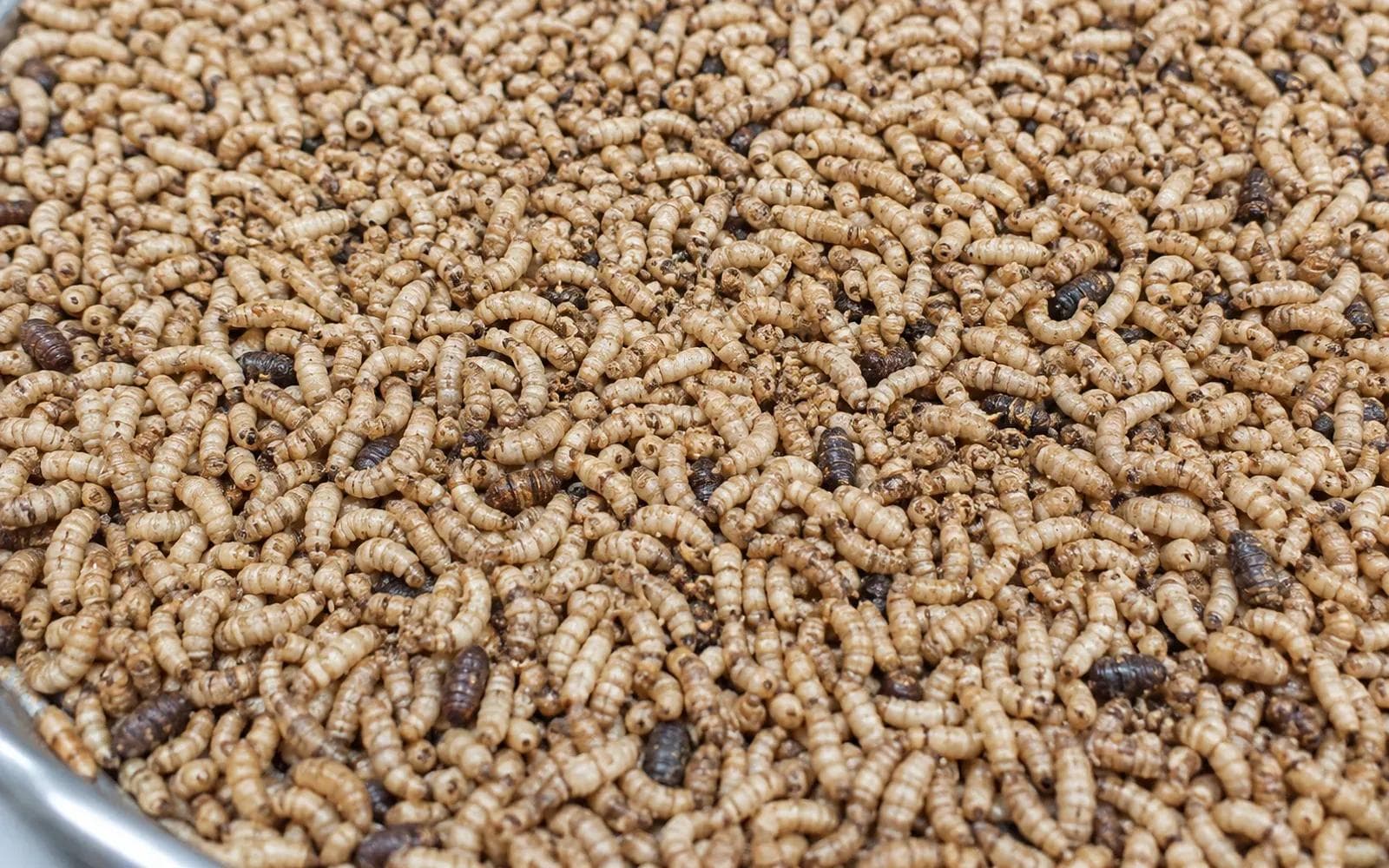
Bitterness is not the only intruding note, but the others ask for the same care. A legume can carry enzymes that, meeting the plant’s own fats, generate green, grassy, beany smells, most notoriously in soybean, though the intensity depends heavily on the raw material and how it was handled. Meat does not smell of cut grass, and an animal may notice the difference even where we have stopped noticing it. Some novel ingredients also arrive wrapped in chitin, the tough material of an insect cuticle or a fungal wall, which can in principle change how a piece breaks and feels in the mouth. But how much chitin, presented in what form, and whether a given cat or dog actually registers it in a finished kibble, are open questions rather than settled facts, and the honest move is to raise them, not assert them.
And there is a distinction worth drawing, provided we draw it as a question and not a verdict. When an animal refuses a new food, is it refusing because the food is genuinely aversive to it, or only because the food is unfamiliar? The two can look identical at the first meeting and diverge by the tenth, because an unfamiliar but harmless food is often accepted over repeated, unpressured exposures, while a genuinely aversive one may not be. Dogs have been seen to hesitate and eat more slowly when first met with a novel diet; cats’ preferences are known to be shaped by experience. But the line is not clean. An aversion can soften with exposure, and an unfamiliarity can prove stubborn, so the question is not which fixed category a refusal belongs to but which way it is moving, and whether anyone watched it long enough to know. An instrument that scores a single first encounter, and much of the industry’s testing does exactly that, cannot see which way the refusal was heading.
Getting this wrong is expensive in both directions. Read an unfamiliarity as an aversion and you abandon a food the animal would have grown into. Read an aversion as mere unfamiliarity and you keep presenting a food that was never going to win, waiting out a refusal that was not fading. So the addition problem is really a cluster of them, chemical and perceptual and temporal at once, and only some of it is yours to engineer. Which raises the question the next movement must face, carefully: when is the cure for one problem bound to the cause of the other, and when is it not?
❦
Movement IV · WHEN ONE MOVE CHANGES THE OTHER
Why not simply do both, then, fill the quiet and remove the intrusion, and meet the animal in the middle? Sometimes you can. That is the correction this movement exists to make, because the tempting story, that every gain in signal buys an equal loss to noise, is too tidy to be true. The real situation is both better and more demanding. The two problems are sometimes coupled, so that the same change moves both, and sometimes they are not, so that a well-chosen change can move one and leave the other largely alone. The difficulty is not that improvement is impossible. It is that we cannot assume a change improves only the thing we aimed it at.
When are they coupled? When the signal and the off-note are made by the same event. The hydrolysis that frees a savoury fragment and the one that exposes a bitter peptide can be, at that moment, the same cut, and asking it for more of the first will sometimes bring more of the second. The reaction that builds a cooked, meaty aroma and the one that builds a scorched or bitter note are the same chemistry run to different extents. Where the same step generates both the wanted and the unwanted, asking for more of one may move the other, and whether that trade-off can be dodged depends on the reaction pathway and the control you have over it. Assume it never can, and you resign yourself to worse food than the chemistry required.
There is more than one dial, and they do not all move signal and noise together.
But coupling is not the law of the whole field, only of certain moves within it. Change the substrate and the balance of savoury to bitter fragments changes with it. Stop the cut at a different point, as No. 7 argued, and the same protein yields a different mixture. The point is not to list the levers here, and I will not, but to correct the fatalism: there is more than one dial, the dials do not all move signal and noise together, and part of the craft is knowing which are coupled on a given substrate and which can be worked apart. That knowledge is specific, hard-won and, frankly, the asset, so this essay will say plainly that the decoupling exists without saying how it is done.
Masking deserves its own caution, because it is the move the trade reaches for most and the one least likely to decouple anything. To lay a louder flavour over an off-note is not to remove the off-note, nor to restore the quiet true signal underneath; it is to add a third thing on top of both. Sometimes it works well enough to sell. But a precise feeder, and some animals are more precise than others, may read the whole stack as wrong rather than be won by it, and the underlying problem, signal too faint or noise too present, is still there beneath the cover. Masking can buy acceptance. It rarely buys a solution.
So the honest shape of the hard problem is not one cruel dial but a question that has to be answered before any dial is touched: for this food, on this substrate, are the two problems coupled or not, and which of them is actually present? That question has no single answer, and it is narrower and more useful than the industry’s reflex, which is to turn up the palatant and hope. It returns us, for the last movement, to the only instrument that finally rules, the animal, and to what its verdict can and cannot tell us about which problem we were ever solving.
❦
Movement V · WHAT THE ANIMAL IS ACTUALLY JUDGING
What is the animal actually judging, when it lowers its head to the bowl or turns away from it? Not the protein, in the sense the formulation sheet means. It does not judge a nutritional category; it judges a food, and it renders on each food a single verdict that folds everything together, the signal and the noise, the savoury and the bitter, the familiar and the strange, into one decision with no partial credit. It does not eat the half we got right and leave the half we got wrong. It eats, or it does not.
That is the quiet reproach buried in this whole subject. We filed the alternative protein under protein, in the protein plans and the protein targets and the protein press, and all the while the animal was not judging the protein. It was judging the taste, the smell and the feel of a food, which is to say it was judging palatability, and palatability does not sit in the protein department. The problem we named for its most expensive ingredient was, in good part, a problem of the senses. We put it in the wrong room, and then wondered why the tools in that room did not fix it.
An animal never judged a protein. It only ever judged a food.
Seen from the bowl, the use of the two-problem distinction is finally plain, and it is diagnostic, not merely descriptive. A low palatability score tells us only that the animal responded differently. It does not tell us why. Several quite different faults produce the same low number: too little of the signal the animal seeks, too much of the note it avoids, a food merely unfamiliar, or some interaction among these. A two-bowl preference ratio cannot tell them apart, and No. 9 asked what lies beyond that bowl for exactly this reason. Yet the remedy for each is different, and some remedies make the others worse. So the first discipline this Conversation asks for is cheap and almost never practised: before you reach for more palatant, find out which problem you actually have.
A low palatability score tells us the animal responded differently. It does not tell us why.
Each of these faults deserves its own return, and some we have visited before, the fat of No. 4, the meat chemistry of No. 2 and No. 3, the cut of No. 7. The Fridays ahead go back to them not as unopened subjects but as open diagnostic questions: not only what the missing signal is, but how to know when it is what is missing; not only whether a cut can turn savour bitter, but when it must and when it need not. The unfamiliar and the aversive most of all deserve to be told apart properly, because an industry that cannot distinguish them is measuring the wrong thing. And a food grown in a tank is already posing the whole question in miniature, signal and noise and novelty at once.
For now, the first and largest thing is only to hold the problem the right way round. We kept calling it a protein problem and reaching for protein’s tools. The animal kept answering the question it was actually asked, which was never about the protein as a category at all. It was about the food. It is always, only, about the food.
References
1. Bradshaw, J.W.S. (2006). The evolutionary basis for the feeding behavior of domestic dogs (Canis familiaris) and cats (Felis catus). Journal of Nutrition 136(7):1927S-1931S. doi:10.1093/jn/136.7.1927S
2. McGrane, S.J., Gibbs, M., Hernangomez de Alvaro, C., Dunlop, N., Winnig, M., Klebansky, B. & Waller, D. (2023). Umami taste perception and preferences of the domestic cat (Felis catus), an obligate carnivore. Chemical Senses 48:bjad026. doi:10.1093/chemse/bjad026
3. Zoran, D.L. (2002). The carnivore connection to nutrition in cats. Journal of the American Veterinary Medical Association 221(11):1559-1567. doi:10.2460/javma.2002.221.1559
4. Saha, B.C. & Hayashi, K. (2001). Debittering of protein hydrolyzates. Biotechnology Advances 19(5):355-370. doi:10.1016/S0734-9750(01)00070-2
5. Rackis, J.J., Honig, D.H., Sessa, D.J. & Steggerda, F.R. (1970). Flavor and flatulence factors in soybean protein products. Journal of Agricultural and Food Chemistry 18(6):977-982. doi:10.1021/jf60172a026
6. Callon, M.C., Cargo-Froom, C., DeVries, T.J. & Shoveller, A.K. (2017). Canine food preference assessment of animal and vegetable ingredient-based diets using single-pan tests and behavioral observation. Frontiers in Veterinary Science 4:154. doi:10.3389/fvets.2017.00154
❦
About the Author
Dr. rer. nat. habil. Dr. Seronei Chelulei Cheison is the founder and Chief Executive Officer of Sinonin Biotech GmbH, where he works with petfood companies on palatant sourcing strategies, the innovation of palatability enhancers, and the design of palatability assessment. A trained food enzymologist, he led alternative protein and palatant development at Mars Petcare before founding Sinonin, and his research on protein chemistry spans two decades, a doctorate from Jiangnan University, and a habilitation from the Technical University of Munich.
❦
Sinonin Biotech GmbH is a partner in the ZEST project (Grant Agreement No. 101157382) and the PROSCALE project (Grant Agreement No. 101288362), both funded by the Circular Bio-based Europe Joint Undertaking (CBE JU) under the European Union’s Horizon Europe research and innovation programme. Views and opinions expressed are those of the author only and do not necessarily reflect those of the European Union or CBE JU. Neither the European Union nor the granting authority can be held responsible for them.
- alternative protein
- Bitterness
- Cat Nutrition
- Dog Nutrition
- pet food formulation
- petfood palatability
- Plant Protein
- Sensory Science
- The Friday Conversation
- Umami