
Palatability | September 1, 2026
Protein Hydrolysate Palatability in Pet Food: Where to Stop the Cut
On protein hydrolysates in petfood: when breaking protein makes food more palatable, when it does not, and why the animal decides where to stop.
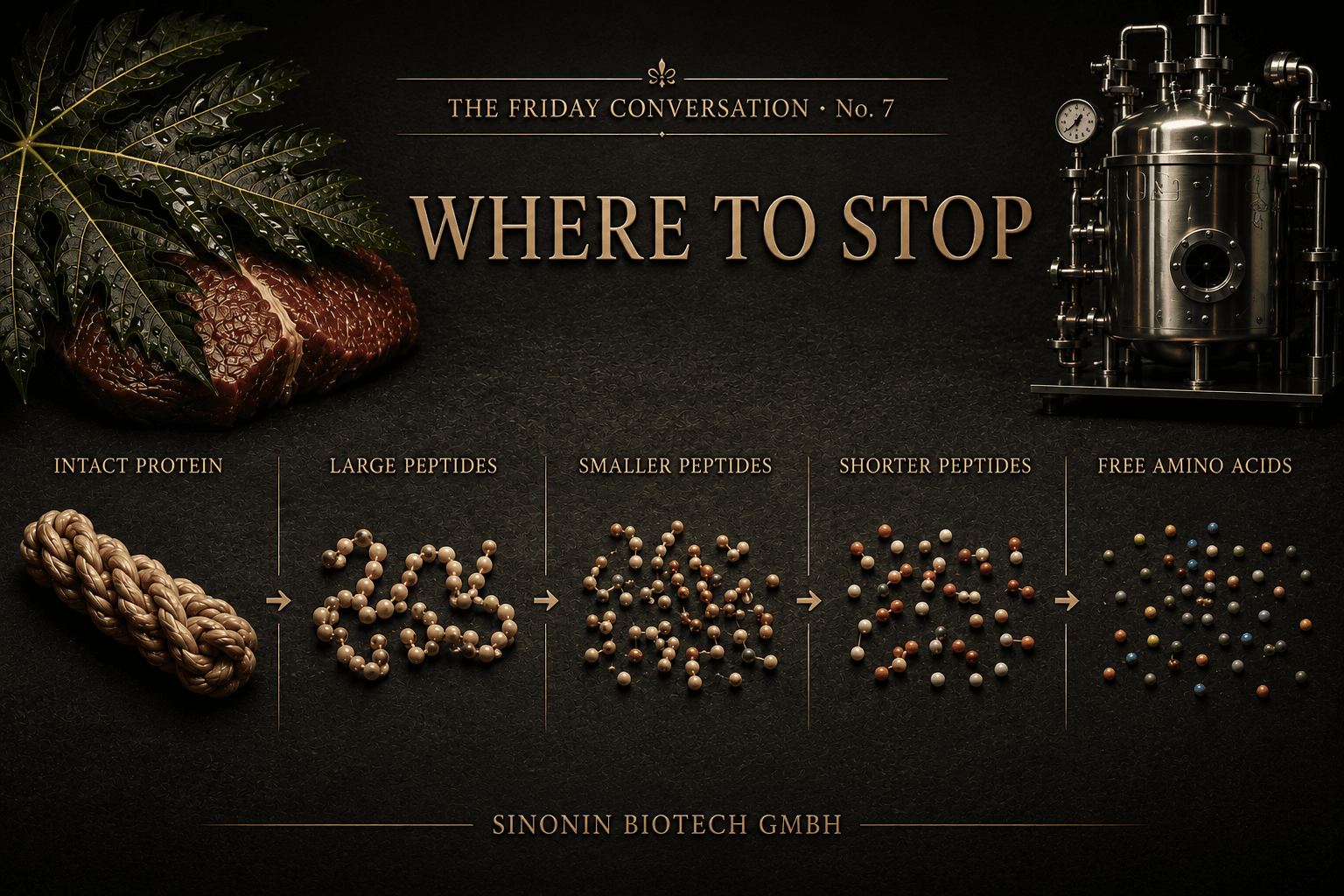
In parts of this world, when the meat is tough, you wrap it in the leaf of the papaya tree and leave it a while before it meets the fire. In others you bury it, or hang it in the cold until the flesh gives up its stiffness on its own. My grandmother’s generation did not call any of this chemistry. They called it good sense, and they were right, and they were also, without a word of the vocabulary, running a controlled enzymatic reaction on a kitchen table.
The papaya leaf carries papain. The pineapple carries bromelain, the fig its ficin, and the meat, left to itself in the cold, carries its own quiet proteases that go on working long after the animal has stopped. All of them do the same thing. They cut the long protein chains of muscle into shorter pieces, and the shorter pieces eat more tenderly, release more savour, and give the tongue more to find. Tenderisation is not softening in the way a soak in water softens. It is scission. It is the protein being taken apart, a little, on purpose, for the pleasure of the eater. And humans have been doing it, deliberately and with real skill, for far longer than they have had a name for the enzyme that does the work.
There is an older cousin to this, and the line between them is thinner than it looks. Long before refrigeration, communities learned to let meat and fish sit under the work of time and microbes, and to prize what came out: the deep, resonant flavour of a cured ham, a fermented fish, a sauce drawn from anchovies left to their own slow dissolution. We call that fermentation, and it is more than enzymes, microbes and time and salt all playing their parts. But enzymes are unmistakably in it, because much of what fermentation does to flavour, it does by proteolysis, by cutting protein into the fragments and free amino acids the tongue reads as savoury. Fermentation for flavour and tenderisation for tenderness are, at the level of the protein, close kin. Both are the controlled disassembly of protein for a sensory reward.
So the question this essay begins with is not a modern one at all. It is the one the grandmother answered with a papaya leaf, asked again with instruments: what happens, exactly, when you take a protein apart, and why has every food culture that ever lived gone to such trouble to do it?
❦
Movement I · FROM THE LEAF TO THE REACTOR
The difference between the papaya leaf and the modern reactor is not the chemistry. It is the control.
When you wrap a tough cut in a papaya leaf, you get whatever the leaf happens to give you, for as long as you happen to leave it, at whatever temperature the kitchen happens to be. The enzyme works where it lands and stops when the heat of the fire finally destroys it, and the result is a better piece of meat and a great deal you never measured. It is real skill, but it is skill of the hand and the eye, passed down and adjusted by taste. What the last century added was not a new reaction. It was the dial. Choose the enzyme, and you choose which bonds along the chain get cut. Choose the temperature and the acidity and the time, and you choose how far the cutting goes. Stop it when you decide to stop it, and you fix the product exactly where you want it. The grandmother cut her protein by feel. The industry learned to cut it to a number.
The grandmother cut her protein by feel. The industry learned to cut it to a number.
That number has a name, the degree of hydrolysis, and it is simply the proportion of the protein’s bonds that have been cut, from a whisper of cleavage to extensive fragmentation into small peptides and free amino acids. Everything that matters in this essay hangs on where along that range you choose to stop, because the protein is a different material at every point, and it behaves differently in the bowl and in the gut depending on where you left it.
This is not a marginal craft. Enzymatic hydrolysis is now a major industrial route to these ingredients, and the trade has grown into a substantial one precisely because controlled cutting turns out to be useful in ways the papaya leaf only hinted at. The proteins that go into it are drawn from wherever good protein can be had: whey and casein from milk, collagen from hide and bone, muscle and organ from slaughter, poultry, and a large and growing share from fish. And increasingly from plants, too, soy above all, along with pea and rice and wheat gluten, which matter more to this story than their share of the market suggests. Plant proteins are where hydrolysis has long been most notorious for the bitterness it can bring, and soy hydrolysate is the substrate on which a great deal of what we know about bitter peptides was first learned. In pet food the pull is strongest at the premium and therapeutic end, where hydrolysates are prized for two properties above all, and it is worth being precise about what those two properties are, because the rest of this essay is about the fact that they do not always come together.
The first is digestibility. A protein already cut into peptides has undergone part of the proteolysis the animal would otherwise perform for itself, and in some formulations and physiological circumstances that can alter the rate and pattern with which its nitrogen becomes available, which matters most for the young, the old, the recovering, and the compromised gut. The second is that extensive hydrolysis can reduce antigenicity, breaking the protein into fragments less able to be recognised by the immune system as the shape it once reacted to, which is why extensively hydrolysed proteins are reached for in the elimination and management diets of the allergic animal. These are real reasons for hydrolysing a protein, and they are why a formulator reaches for the tool. But neither of them tells us whether the resulting food will be eaten. Both are reasons of the gut, not the mouth, and a diet the animal refuses has a nutritional value of zero no matter how digestible or how hypoallergenic it is on paper. So the question this essay is really about is not what hydrolysis does to a protein. It is what hydrolysis does to a protein’s chances at the bowl. And there the story stops being a list of benefits and becomes something far less obedient.
❦
Movement II · THE SAME CUT
Here is the thing the papaya leaf never had to reckon with, because it never cut very far. The same scission that delivers the digestibility and the hypoallergenicity also does two other things, in the same stroke, that no one asked it to do. It is not that hydrolysis has a benefit and, separately, a side effect. It is that the cut is single and its consequences are plural. You cannot take the protein apart for one reason and leave the other reasons uninvited.
Consider what the cut does to taste, which turns out to be two opposing things at once. Cleaving protein releases free amino acids and small peptides that profoundly change flavour, and to a human tongue some of them carry a savoury character, the deep meaty resonance that has drawn every long-cooked stew and every aged cheese and every drop of fish sauce toward the same chemistry. But here the caution this whole series keeps returning to becomes almost the point. The cat does not read that chemistry as we do. Its savoury sense, the work of the palatability scientists tells us, is not built around glutamate the way ours is; it appears to lean more on nucleotides, with amino acids playing a supporting part, and the glutamate and aspartate that anchor the human idea of umami do not map cleanly onto how a cat responds at all. Kokumi, the mouth-filling roundness that is less a taste than an enrichment of the others, appears to be functional in the cat too, one more channel through which a broken-down protein might reach the animal.
So when hydrolysis unlocks a savour that sat mute inside the intact chain, we should be careful whose savour we mean, and honest that we do not fully know which of these channels a given cut is feeding, and which it is starving. We can release the molecules confident that they are appetising and be describing our own tongue rather than the animal’s. But whatever the cat makes of that half, the very same cutting, carried further or aimed differently, can also do the opposite. It exposes the hydrophobic amino acids that had been folded safely inside the protein, and hydrophobicity is strongly associated with bitterness, though it is not the whole story. Hydrophobicity is a useful first clue to where the bitterness may reside, never a complete explanation of it: the more hydrophobic peptides tend to be both the more bitter ones and the ones that behave differently when you try to separate a hydrolysate by that property.
Some years ago I worked on exactly this, removing the bitterness and the salt from a whey protein hydrolysate at the same time by letting the bitter, hydrophobic peptides interact selectively with an adsorbent and lifting them out on that interaction. It works because bitterness is not scattered randomly through a hydrolysate; it rides on a physical characteristic you can act on. But knowing that bitterness and hydrophobicity travel together is a long way from knowing, for a given protein and a given purpose, where the balance tips. And the relationship between how far you cut and how bitter the result is turns out to be more interesting than a straight line. Bitterness depends on the substrate, the sequence, the size of the peptides and the specificity of the enzyme, and as the cutting proceeds it can rise as bitter hydrophobic peptides are liberated, peak, and even fall again as further cutting breaks those same peptides down. Every cut changes the peptide population, and the bitterness rides that changing population up and down rather than simply climbing. There is no monotonic dial you can simply turn less of. There is a moving target.
The cat makes this harder still, and in a way that ought to keep us humble. An obligate carnivore might be expected to have surrendered much of the bitter-detection apparatus that other animals use to avoid the toxins of plants. It did not; the domestic cat carries a substantial repertoire of bitter receptors that respond, in the laboratory, to bitter compounds. But a receptor firing in a dish is not the same as an animal tasting bitterness, still less disliking it, and the older work on how cats actually respond to bitter stimuli is genuinely murky, some of it pointing to responses that lack the clean specificity we would want before saying with any confidence what the cat perceives. So the honest position is a question rather than a claim. We know the cat kept the machinery, and we know a little of what it does with some of it: cats will reject quinine, so the apparatus is not idle. But quinine is a plant alkaloid, and the bitterness a hydrolysate carries is a different chemistry, a matter of peptides and exposed residues, and how the cat meets that is far less clear. We call these bitter receptors, but they earn the name only by resemblance to ours; the label is borrowed from the one species that can say what it tastes. When the cat’s version fires, we do not actually know that the animal experiences bitterness as we would recognise it. The researchers who first characterised these receptors said as much, that the cat may detect a narrower, or simply a different, range of bitter things than we do, and that its bitter world has scarcely been studied. It might register something we have no word for, and the cat cannot tell us, because the one instrument that could settle the matter, its own report, is the one a cat does not have.
So the questions stack. Does the bitterness a cut liberates register at all in the cat; if it does, does it register as bitterness or as some other thing we cannot name; and if as bitterness, does a carnivore that meets such compounds in prey rather than in poison read them as an aversion to be masked, or make very little of them? I do not think anyone can answer that from a receptor, and until someone answers it some other way, a great deal of what we say about bitter hydrolysates and cats is really being said about our own tongues. The savour and the bitterness are not two ingredients you can order separately. They are two faces of the one act of cutting, and where you stop decides which face is showing.
The same cut that unlocks the savour exposes the bitter. You do not get to invite one and refuse the other.
Now consider what the cut does to structure, and here the essay meets its two predecessors. An intact protein can build things. It can be heat-set into a gel, woven into a network that holds water and fat and gives a chunk its bite, which is the entire subject of the two conversations that came before this one. Cut that protein into peptides and you take that ability away. A hydrolysed protein has been relieved of the very architecture that let it bind, because the long chains that entangled and cross-linked and held are now short pieces that cannot. So the tool that improves digestion dismantles structure in the same motion. The gain in digestibility is paid for in structure, and the loss is not incidental. It is the direct arithmetic of cutting a long thing into short things.
This is why there is no single best form of a protein, only a best form for a purpose, and it is worth laying the spectrum out honestly. At one end sits the intact protein: full structure, its savour locked up, and asking the animal’s gut to do the work of breaking it down. At the far end sits the pool of free amino acids: no peptide bonds left for a protease to cleave, no peptide structure left to build a network with, and a sensory character that can be powerful without necessarily being attractive. And in the enormous middle sits the hydrolysate, wherever you chose to stop it, carrying some of each virtue and some of each cost. But it would be too tidy to call this a single spectrum with the good things at one end and the bad at the other. Every movement of the dial changes several properties at once, and they do not move in step, and they do not reach their best points together. Digestibility, structure, savour, bitterness: each follows its own curve as the cutting proceeds, rising and falling on its own schedule, and the peaks and troughs do not line up. The dial does not have a setting that is best at everything, and not merely because the properties compete along a line, but because they are several different response curves laid over one another, and no single point sits at the top of all of them.
❦
Movement III · WHEN A HYDROLYSATE IS NOT A PALATANT
The word hydrolysate describes what we did to the protein. The word palatant describes what the animal thought of the result. They are not the same word, and they do not always describe the same thing, and the entire difficulty of this trade lives in the gap between them.
A hydrolysate can be, by every measure a laboratory can put to it, an excellent thing. Its nitrogen readily available, its antigenicity low, its solubility complete, its amino acid profile answering the animal’s needs point for point. And it can still be met at the bowl with refusal, because none of those virtues is the same as being wanted. The cut that made it so digestible may have carried the bitterness up onto its peak. The peptides that make it dissolve so cleanly may be exactly the ones the cat’s kept receptors object to. A protein can be hydrolysed perfectly for nutrition and badly for palatability, and the two failures are invisible to each other. The nutritionist’s instruments will report a triumph while the animal walks away.
Hydrolysate describes what we did to the protein. Palatant describes what the animal thought of the result.
Collagen offers a particularly visible demonstration of what progressive dismantling can do, because it has been walked down that road in front of us for a century. In its native state it is highly ordered and structurally formidable, with real technological and nutritional consequences of its own. Disrupt that ordered triple helix through denaturation and partial hydrolysis into gelatine, and its behaviour changes dramatically: it becomes dispersible and can set a thermoreversible gel, a reminder in passing that the cut can be made by chemistry as readily as by the papaya leaf’s biology. Hydrolyse it further into smaller collagen peptides and that gel-forming capacity largely disappears, leaving a soluble, available fragment that builds nothing. One parent protein, progressively dismantled into materials with profoundly different functions, and not one point along that road that is best at everything. Where you would stop, for collagen or for any protein, depends entirely on what you were trying to make, and whether the animal agrees is a separate question the road cannot answer.
None of this is waste rescued from a bin. The tougher streams a slaughter leaves, the connective tissue and the harder material, are already valorised into the rendered meals and fats that are real ingredients in their own right, and hydrolysis is simply a further rung on that ladder, a way of taking something already useful and giving it a different functionality, perhaps more soluble, perhaps more digestible, and potentially more useful within a palatability system. But none of those transformations guarantees that the animal will want it. You can climb every rung of nutrition and functionality and still arrive at a material the animal declines, because willingness is not a rung on that ladder at all. It is the judgement waiting at the top, and it belongs to the eater.
Which leaves a question worth sitting with, if you make or buy these ingredients. Before the animal has told you, how would you know whether the excellent hydrolysate in front of you is a good palatant? What, exactly, would you measure? We have instruments for every rung of the ladder and none for the judgement at the top, and I am not sure the industry has been honest with itself about how much of what it calls palatability prediction is really just the hope that the two will coincide.
❦
Movement IV · WHERE TO STOP
So the whole art, in the end, comes down to a decision the papaya leaf never had to make consciously: where to stop the cut.
Stop too early and the protein may remain little changed, much of its original structure intact, its immunoreactive epitopes potentially preserved, and whatever sensory potential the cutting might have released still largely locked away. Cut too far and you have a pool of free amino acids that the gut absorbs in an instant, the structure gone entirely and the savour at risk of tipping over into a rawness the animal may or may not accept. Somewhere between those, for any given protein and any given purpose, there is a place to stop that gives the animal enough of what it needs and spares it enough of what it will not tolerate. That place is different for a hypoallergenic diet than for a digestibility aid, different for a fish protein than for a collagen, different for a cat than for a dog. It is not one setting. It is a judgement made freshly each time, against the specific material and the specific animal and the specific job the ingredient has to do.
I am not going to tell you, in this essay, how that judgement is made. Partly because it is the working life of people like me and not a thing to be given away in a Friday paragraph, but also because the answer is not a universal number. It belongs to the substrate, the process, the purpose, and, ultimately, the species doing the eating. It is the accumulated feel for a tool that the industry has spent decades learning, the modern inheritor of exactly the skill the grandmother had with her leaf, only now aimed with instruments and held to a number. What can be said plainly is what the decision is between, and this whole conversation has been an attempt to say it: between digestion and structure, between savour and bitterness, between what the gut will take and what the mouth will accept, all of them moving at once, all of them tied to the single fact of the cut.
There is no setting that is best at everything. There is only the setting that is best for this.
And here is where the title of this conversation finally asks its real question. Where to stop the cut is not, in the end, a question the laboratory can close. You can measure the degree of hydrolysis. You can measure the size of the peptides and the quantity of free amino acids, the solubility, the digestibility, and with enough patience even the bitterness. There are instruments now, electronic tongues and noses and the models built on top of them, that read these properties and predict, sometimes rather well, how a food is likely to be received. But prediction is not preference, and correlation is not consent. Every one of those readings is a number, and not one of those numbers is the animal’s yes. The best of them forecast the verdict. None of them is the verdict. Which ought to unsettle us more than it does, because we specify these ingredients to numbers all the same. When we write a hydrolysate to a target, are we describing what the animal will accept, or only what the quality sheet can check? The two are not the same, and the gap between them is where a great many refused bowls have quietly lived.
The laboratory measures hydrolysis. The animal measures palatability.
The grandmother knew when the meat was ready. She knew it the way you know these things, by the eating. We have better tools than she had, and a great many more numbers, but at the very end we are still waiting on the same verdict she was, and it is not a verdict any instrument can return. We can say, with all the precision in the world, exactly how far we cut the protein. Only the animal can tell us whether we stopped in the right place.
Which means the question was never really only where to stop the cut. It was how to learn to ask the animal sooner, before the batch is made, before the diet is formulated, and before the refusal comes back from the bowl too late to do anything about it. I do not think we have answered that question yet. I am not sure we have been asking it in the right language. And that, more than any degree of hydrolysis, is the conversation I would like us to be having.
The bowl, as always, decides.
References
1. Cheison, S.C., Wang, Z. & Xu, S.-Y. (2007). Use of macroporous adsorption resin for simultaneous desalting and debittering of whey protein hydrolysates. International Journal of Food Science & Technology 42(10):1228-1239. doi:10.1111/j.1365-2621.2006.01461.x
2. Cheison, S.C. & Kulozik, U. (2017). Impact of the environmental conditions and substrate pre-treatment on whey protein hydrolysis: A review. Critical Reviews in Food Science and Nutrition 57(2):418-453. doi:10.1080/10408398.2014.959115
3. Liu, B., Li, N., Chen, F., Zhang, J., Sun, X., Xu, L. & Fang, F. (2022). Review on the release mechanism and debittering technology of bitter peptides from protein hydrolysates. Comprehensive Reviews in Food Science and Food Safety 21(6):5153-5170. doi:10.1111/1541-4337.13050
4. Fu, Y., Chen, J., Bak, K.H. & Lametsch, R. (2019). Valorisation of protein hydrolysates from animal by-products: perspectives on bitter taste and debittering methods. International Journal of Food Science & Technology 54(4):978-986. doi:10.1111/ijfs.14037
5. McGrane, S.J., Gibbs, M., Hernangomez de Alvaro, C., Dunlop, N., Winnig, M., Klebansky, B. & Waller, D. (2023). Umami taste perception and preferences of the domestic cat (Felis catus), an obligate carnivore. Chemical Senses 48:bjad026. doi:10.1093/chemse/bjad026
6. Laffitte, A., Gibbs, M., Hernangomez de Alvaro, C., Addison, J., Lonsdale, Z.N., Giribaldi, M.G., Rossignoli, A., Vennegeerts, T., Winnig, M., Klebansky, B., Skiles, J., Logan, D.W. & McGrane, S.J. (2021). Kokumi taste perception is functional in a model carnivore, the domestic cat (Felis catus). Scientific Reports 11:10527. doi:10.1038/s41598-021-89558-w
7. Sandau, M.M., Goodman, J.R., Thomas, A., Rucker, J.B. & Rawson, N.E. (2015). A functional comparison of the domestic cat bitter receptors Tas2r38 and Tas2r43 with their human orthologs. BMC Neuroscience 16:33. doi:10.1186/s12868-015-0170-6
8. Lei, W., Ravoninjohary, A., Li, X., Margolskee, R.F., Reed, D.R., Beauchamp, G.K. & Jiang, P. (2015). Functional analyses of bitter taste receptors in domestic cats (Felis catus). PLoS ONE 10(10):e0139670. doi:10.1371/journal.pone.0139670
9. Cho, M.J., Unklesbay, N., Hsieh, F.-H. & Clarke, A.D. (2004). Hydrophobicity of bitter peptides from soy protein hydrolysates. Journal of Agricultural and Food Chemistry 52(19):5895-5901. doi:10.1021/jf0495035
10. Schrieber, R. & Gareis, H. (2007). Gelatine Handbook: Theory and Industrial Practice. Wiley-VCH, Weinheim.
❦
About the Author
Dr. rer. nat. habil. Dr. Seronei Chelulei Cheison is the founder and Chief Executive Officer of Sinonin Biotech GmbH, where he works with petfood companies on palatant sourcing strategies and the innovation of palatability enhancers. A trained food enzymologist, he led alternative protein and palatant development at Mars Petcare before founding Sinonin, and his research on enzymatic protein hydrolysis spans two decades, a doctorate from Jiangnan University, and a habilitation from the Technical University of Munich.
❦
Sinonin Biotech GmbH is a partner in the ZEST project (Grant Agreement No. 101157382) and the PROSCALE project (Grant Agreement No. 101288362), both funded by the Circular Bio-based Europe Joint Undertaking (CBE JU) under the European Union’s Horizon Europe research and innovation programme. Views and opinions expressed are those of the author only and do not necessarily reflect those of the European Union or CBE JU. Neither the European Union nor the granting authority can be held responsible for them.
- Alternative proteins
- bitter peptides
- Cat Nutrition
- collagen hydrolysate
- debittering
- degree of hydrolysis
- digestibility
- enzymatic hydrolysis
- feline taste
- free amino acids
- gelatine
- hydrophobicity
- kokumi
- palatability enhancers
- palatants
- peptides
- pet food formulation
- pet food palatability
- protein hydrolysate
- protein hydrolysis
- Sinonin Biotech
- soy protein hydrolysate
- Umami
- whey protein hydrolysate