
Palatability | November 19, 2026
The Meat Is Not the Species
**The Meat Is Not the Species.** We call a food chicken, beef, lamb or pork, but the animal never meets a species name. It meets liver, heart, muscle or kidney, each with its own chemistry, texture and flavour, remade by processing and read through its own senses. A cat may prefer lamb to beef and still split evenly be
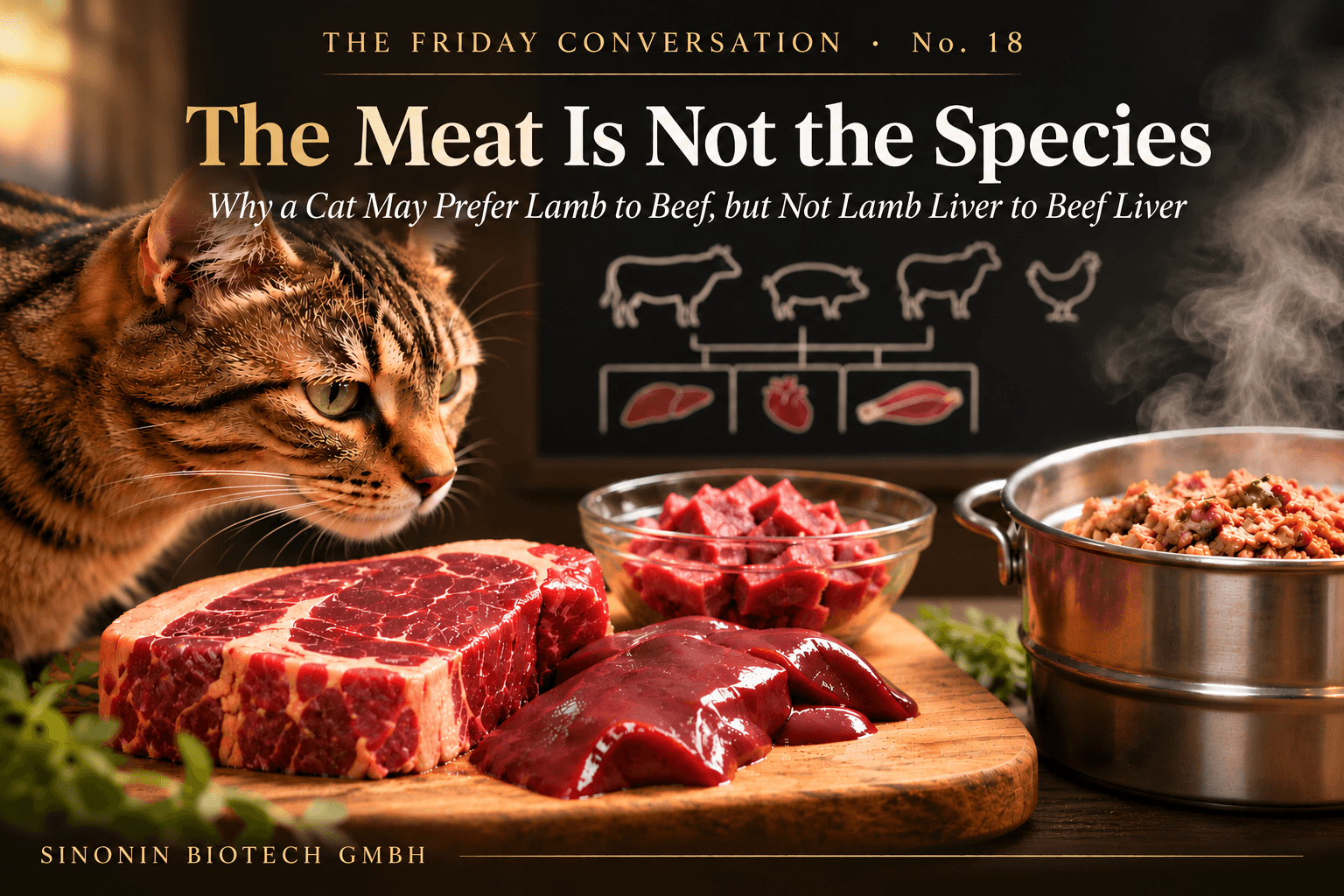
Why a Cat May Prefer Lamb to Beef, but Not Lamb Liver to Beef Liver
Movement I · THE ANIMAL DOES NOT READ THE LABEL
Do two different meats, cooked together in one pot, agree or clash? The question is older than pet food, and a kitchen is the place to meet it. Take a good piece of beef steak and some pork liver, mince them together, steam the mixture, and serve it. Both are meat. Both are nutritious. Both are perfectly acceptable foods on their own. But does bringing them together make the result more appetising?
Perhaps. Perhaps not.
The beef brings its muscle proteins, its fat, its characteristic flavour precursors and the structure of skeletal muscle. The liver brings something else entirely: a metabolically specialised tissue with its own lipids, free amino acids, nucleotides, iron-containing compounds and distinctive flavour. Steam them together and the result is not simply beef flavour plus pork-liver flavour. Their compounds interact during heating, their aromas compete or complement, and their structures become part of a new food.
The liver may lend the beef a deeper savoury character. It may equally overwhelm the beef with an organ note that some find metallic, bitter, or simply too much. A little may improve the mixture; more may spoil it. And a different preparation, a mixed goulash simmered slowly with vegetables and spices, may bring the very same meats into easy agreement.
So what happened? Did beef and pork clash? Did the liver overwhelm the muscle? Did cooking make something neither meat held alone? Or did the proportions simply cross the point where one flavour stopped flattering the other? These are different explanations, and they matter. Flavours can reinforce one another or suppress one another, as the study of taste mixtures documents, or change character as their precursors react under heat. The liking of a mixture cannot always be predicted from the liking of its individual ingredients. But a clash between beef and pork liver would not, by itself, establish a clash between beef and pork as species. Swap the pork liver for pork muscle, or the beef muscle for beef liver, and we may have a different food and a different verdict. Two meats can be palatable apart and less palatable together, and the species need not be the reason.
Now put the question in front of a cat.
We call its food chicken, beef, lamb or pork, and we treat those names as though they describe four distinct sensory experiences. But the cat never meets a species name. It meets liver, heart, muscle, kidney, or some combination of them, each with its own chemistry, texture and flavour, altered by processing and presented inside a finished food.
The label names a species. The animal tastes a tissue.
Suppose the cat prefers lamb to beef. Has it preferred the species? The tissue? The fat? The aroma? The texture? And would it make the same choice if both bowls held liver instead of muscle?
This series argued in No. 3 that meat is more than protein. The question now goes further: meat is not even one uniform sensory material within a species. A chicken liver is not chicken breast. A beef heart is not beef liver. Pork kidney is not pork muscle. And a lamb liver may, in some biochemical respects, resemble beef liver more closely than it resembles lamb skeletal muscle.
Species-associated differences are real, and they can shape lipid composition, flavour precursors and the compounds formed during cooking. But anatomical tissue, processing, and the interactions between ingredients can shape the sensory result just as deeply. So before asking which species an animal prefers, there is a more basic question to settle: which part of the animal, prepared how, and combined with what?
❦
Movement II · THE LIVER AND THE MUSCLE
What happens to a species ranking when you stop comparing whole animals and start comparing their parts? There is an experiment that does exactly that, and it is unusually informative.
In 2020, Watson and colleagues investigated the acceptance and preference of raw lamb and beef components in domestic cats. Rather than treating lamb and beef as single ingredients, they examined liver, kidney, heart, lung, tripe and mechanically deboned meat separately. The results refuse any simple ranking by species.
Within both lamb and beef, liver was the most highly accepted component. Lamb kidney performed comparably to lamb liver, and mechanically deboned meat was the least accepted within each species. When equivalent tissues were compared between species, cats generally preferred lamb to beef, with two exceptions that carry the whole argument: for liver and for heart, the difference between the species was not statistically significant.
A distinction is worth drawing before we read too much into the numbers. Eating nearly all of a liver portion tells us the preparation was readily accepted. Choosing lamb over beef when both are offered tells us something else. And telling two preparations apart is different again from preferring one. Acceptance, preference and discrimination are three different questions, and no single result answers all three, nor names the sensory property responsible.
Read that again, because it is the hinge. The apparent advantage of lamb was not consistent across tissues; it held for several and vanished for liver and heart. Whether that pattern reflects a statistically demonstrable species-by-tissue interaction, rather than separate comparisons landing on different sides of significance, is a further question the study was not built to settle.
Why the two livers should draw is worth sitting with rather than answering too quickly. Liver is a metabolically specialised organ with a distinctive biochemical composition, rich in free amino acids, nucleotides, lipids, iron-containing proteins and other metabolites, some contributing directly to taste, others becoming aroma precursors under heat. It is at least plausible that the biochemical character of an organ can, in some preparations, weigh more heavily on the senses than the species it came from. But the Watson experiment did not establish that mechanism. A non-significant difference between lamb and beef liver is an observation to explain, not proof that liver chemistry overwhelmed species identity.
A liver is not merely another cut of meat. It is a different biochemical starting material.
The evidence has limits, and they should be stated plainly. The study used eight cats and raw ingredients. It did not establish which chemical or physical properties drove the preferences, and a non-significant difference is not proof that two ingredients are equivalent. What it gives us is a foothold: tissue identity may substantially modify the apparent influence of species.
And pork?
The evidence grows more interesting and less complete. The firmest statement comes from Houpt and Smith, who reported dogs preferring beef, pork and lamb to chicken, liver and horsemeat under the laboratory conditions they examined. An earlier study by Houpt, Hintz and Shepherd examined the role of olfaction in canine food preferences, a reminder that smell is part of how these choices are made, though not the whole of it. These are genuine findings, but they are old, and they should not be stretched over today’s commercial formulations without qualification.
The feline evidence shows why the kind of measurement matters. Decades of electrophysiology, beginning with Boudreau’s recordings from the cat’s taste nerves, established that the feline taste system responds to meat-derived stimuli and to specific compounds within them. But a neural response shows only that a stimulus was detected under the recording conditions. A meat-derived stimulus may evoke a strong response in recorded feline taste neurones without establishing that the cat will prefer that meat to another when both are offered.
So the honest conclusion is narrower than a universal species ranking, and more interesting than one: meat sources can produce different sensory responses, and the apparent preference depends on the tissue, the preparation, the species of the animal doing the choosing, and the method by which we measured.
❦
Movement III · WHAT MEAT IS MADE OF
Why should liver behave differently from muscle, or pork differently from beef? The answer begins with composition, but it does not end with the proximate analysis.
Protein, fat, moisture and ash tell us something real about an ingredient. They do not tell us what it will smell or taste like. Two tissues can carry comparable crude protein and still differ sharply in their amino-acid profiles, free amino acids, peptides, nucleotides, lipids, minerals and metabolites, because perception depends on particular molecules and their availability, not on the totals a formulation records.
Proximate analysis counts what is present. The animal tastes only what reaches it.
Consider the fat, because lipids contribute much of what distinguishes one meat from another, particularly after cooking. As Mottram’s review of meat-flavour formation sets out, the water-soluble and Maillard precursors give much of the savoury character shared across meats, while differences in lipid composition and lipid-derived volatiles help set their characteristic profiles apart. This is No. 4 arriving by another road: the fat carries much of the signal, and much of what we hear as species. Pork fat, beef fat, lamb fat and chicken fat do not share a fatty-acid profile, and those profiles are not fixed within a species either, shifting with diet, tissue, breed, age and husbandry. So a preference we attach to pork may ride partly on its particular lipid, and the lipid is a movable thing.
Now the water-soluble fraction. Free amino acids, peptides, nucleotides, reducing sugars and other small metabolites contribute to taste directly and feed the reactions that build aroma under heat. Their concentrations differ among tissues and vary among species. In the cat especially, the savoury response turns on interactions between particular amino acids and nucleotides, as No. 16 set out, and those are stocked differently by a liver than by a muscle. Yet more is not simply better: thresholds, interactions between compounds, concentration-dependent effects and the food matrix all intervene between a molecule’s presence and the animal’s verdict.
This is why proximate composition is necessary and insufficient at once. It says how much protein and fat an ingredient holds. It does not say which compounds reach the animal’s receptors, at what concentration, or to what effect.
And we have not yet touched texture. Liver, heart, kidney and skeletal muscle differ in their physical architecture, their connective tissue, their cellular organisation, their structural proteins, and so in firmness, cohesiveness, fracture and the work of chewing. A soft liver behaves in the mouth unlike a fibrous muscle. Grinding alters that relationship, and cooking alters it again. So if a cat eats more liver than mechanically deboned meat, we cannot conclude that liver simply tastes better. Mechanically deboned meat is itself a distinct preparation, its composition and structure set by the tissues entering the process and the conditions of separation, and its lower acceptance here cannot be pinned confidently on flavour, oxidation or texture without separating those influences. The preparations differ in texture, particle size, moisture and aroma release as much as in flavour.
An animal’s preference for a meat preparation is not necessarily a preference for its flavour alone.
❦
Movement IV · THE COOK CHANGES THE CONTEST
Does a preference measured on one raw tissue survive the cook? We do not know until we test it.
Raw chicken, beef, lamb and pork livers begin with different biochemical compositions. Commercial manufacture rarely leaves those compositions alone. Grinding changes particle size and structure. Heating denatures proteins and remakes texture. Hydrolysis releases peptides and amino acids. Thermal reactions generate new aroma compounds. Retorting imposes the heavy thermal history No. 17 described on wet food, while extrusion and coating work their own transformations on dry, the processing No. 14 called the invisible palatant. The original ingredient becomes part of a new chemical and physical system.
This sharpens a real question for palatant development, and it is worth stating at the level of principle rather than method. If two different livers are hydrolysed under the same nominal conditions, will they yield the same sensory profile? Not necessarily. The substrates differ in protein composition, accessibility, endogenous compounds and lipid, so even at a similar extent of hydrolysis the peptide distributions, the free-amino-acid profiles and the other soluble fractions can differ. Subject those to further controlled reaction and the differences in precursor availability can steer the volatiles that form. Processing can preserve some species-associated distinctions, diminish others, or create sensory differences that were not apparent in the raw material.
Texture tells the same story. A preference for a raw tissue’s structure may vanish once it is finely comminuted into a pâté, while differences in protein functionality, fat and connective tissue may still shape the finished texture long after the anatomy is unrecognisable.
And there is a further gap to respect: ingredient palatability is not finished-food palatability. A highly accepted raw ingredient does not guarantee the most palatable complete diet, because its contribution depends on inclusion level, interaction with other ingredients, the fat system, the added palatant and the matrix it lands in. Which is why the species question cannot be closed by comparing raw meat.
The species name survives the cook. The chemistry that carried it may not.
The animal may prefer one tissue raw, another once cooked, and respond differently again when both are built into complete foods. The species name on the pack never changes. The sensory system reading it does.
❦
Movement V · WHAT DID THE ANIMAL PREFER?
When the cat eats more lamb than beef, what, exactly, have we established? Return to the two bowls, lamb in one and beef in the other, and suppose the lamb empties faster.
We have established a preference between two preparations under the conditions of one experiment. We have not established an inherent preference for lamb as a biological species. To make the stronger claim, we would need to know what differed between the preparations, and whether the result held when those differences were controlled or systematically varied.
A preference is a fact about a bowl. It is not yet a fact about a species.
A useful design would begin with four species, chicken, beef, lamb and pork, and several defined tissues, liver, heart, kidney and skeletal muscle. That is sixteen ingredient combinations before any processing enters. We would compare tissues within each species and species within each tissue, then ask whether the differences persist after a standardised cook. The design would need more than a palatability score beside it: proximate composition, lipid and fatty-acid profiles, selected free amino acids and nucleotides, volatile compounds and the relevant texture properties, with temperature, particle size, presentation and prior dietary exposure controlled or measured, several independent ingredient sources drawn for each species so that the gap between four particular lots is not mistaken for the gap between four species, and the individual animal handled properly in the statistics.
The critical question would not be whether chicken differs from pork, or lamb from beef. It would be whether the effect we attribute to species depends on tissue and processing, and whether the chemical and physical differences we measured actually explain what the animal did. Even then, correlation is not cause. Finding more of a particular volatile in the preferred preparation does not establish that the volatile caused the preference; that would require a further experiment in which the candidate sensory factor is manipulated independently.
And the animal brings its own variance. Cats and dogs differ in sensory physiology, feeding behaviour and selection; individual animals differ in prior exposure, learned association and willingness to try the unfamiliar. A preference seen in one population need not transfer to another.
None of this argues against using species as a formulation variable. It argues for knowing what species represents. Chicken, beef, lamb and pork are biologically meaningful origins. But each is also a collection of tissues, each tissue a complex biochemical material, and each material a substrate for processes that can remake its sensory identity. The food finally set before the animal is the product of all of it.
We can name its species. We can measure its composition, describe its texture, identify its volatiles, record how much the animal ate. No one of these measurements, taken alone, explains the preference. So perhaps the better question is not whether cats and dogs prefer chicken, beef, lamb or pork. It is whether we have separated the effects of species, tissue, composition, texture, processing and the company of other ingredients well enough to know what the animal actually chose.
When an animal chooses one meat over another, it has not told us why. That is where the science begins.
References
1. Watson, P.E., Thomas, D.G., Hoggard, A., Parker, M.E. & Schreurs, N.M. (2020). Investigating the palatability of lamb and beef components used in the production of pet food for cats. Animals 10(4):558. doi:10.3390/ani10040558
2. Houpt, K.A., Hintz, H.F. & Shepherd, P. (1978). The role of olfaction in canine food preferences. Chemical Senses and Flavour 3(3):281-290. doi:10.1093/chemse/3.3.281
3. Houpt, K.A. & Smith, S.L. (1981). Taste preferences and their relation to obesity in dogs and cats. Canadian Veterinary Journal 22(4):77-81. PMC1789883
4. Watson, P.E., Thomas, D.G., Bermingham, E.N., Schreurs, N.M. & Parker, M.E. (2023). Drivers of palatability for cats and dogs: what it means for pet food development. Animals 13(7):1134. doi:10.3390/ani13071134
5. Mottram, D.S. (1998). Flavour formation in meat and meat products: a review. Food Chemistry 62(4):415-424. doi:10.1016/S0308-8146(98)00076-4
6. Boudreau, J.C. (1977). Chemical stimulus determinants of cat neural taste responses to meats. Journal of the American Oil Chemists' Society 54:464-466. doi:10.1007/BF02671037
7. Keast, R.S.J. & Breslin, P.A.S. (2003). An overview of binary taste-taste interactions. Food Quality and Preference 14(2):111-124. doi:10.1016/S0950-3293(02)00110-6
❦
About the Author
Dr. rer. nat. habil. Dr. Seronei Chelulei Cheison is the founder and Chief Executive Officer of Sinonin Biotech GmbH, where he works with petfood companies on palatant sourcing strategies, the innovation of palatability enhancers, and the design of palatability assessment. A trained food enzymologist, he led alternative protein and palatant development at Mars Petcare before founding Sinonin, and his research on protein chemistry spans two decades, a doctorate from Jiangnan University, and a habilitation from the Technical University of Munich.
❦
Sinonin Biotech GmbH is a partner in the ZEST project (Grant Agreement No. 101157382) and the PROSCALE project (Grant Agreement No. 101288362), both funded by the Circular Bio-based Europe Joint Undertaking (CBE JU) under the European Union’s Horizon Europe research and innovation programme. Views and opinions expressed are those of the author only and do not necessarily reflect those of the European Union or CBE JU. Neither the European Union nor the granting authority can be held responsible for them.
- Animal Protein
- Cat Nutrition
- Dog Nutrition
- Flavour Chemistry
- Food Science
- Liver
- Meat Species
- Organ Meats
- pet food formulation
- petfood palatability
- The Friday Conversation
- Tissue Chemistry