
Palatability | September 10, 2026
Petfood Palatability: The Physical Signals That Drive Preference
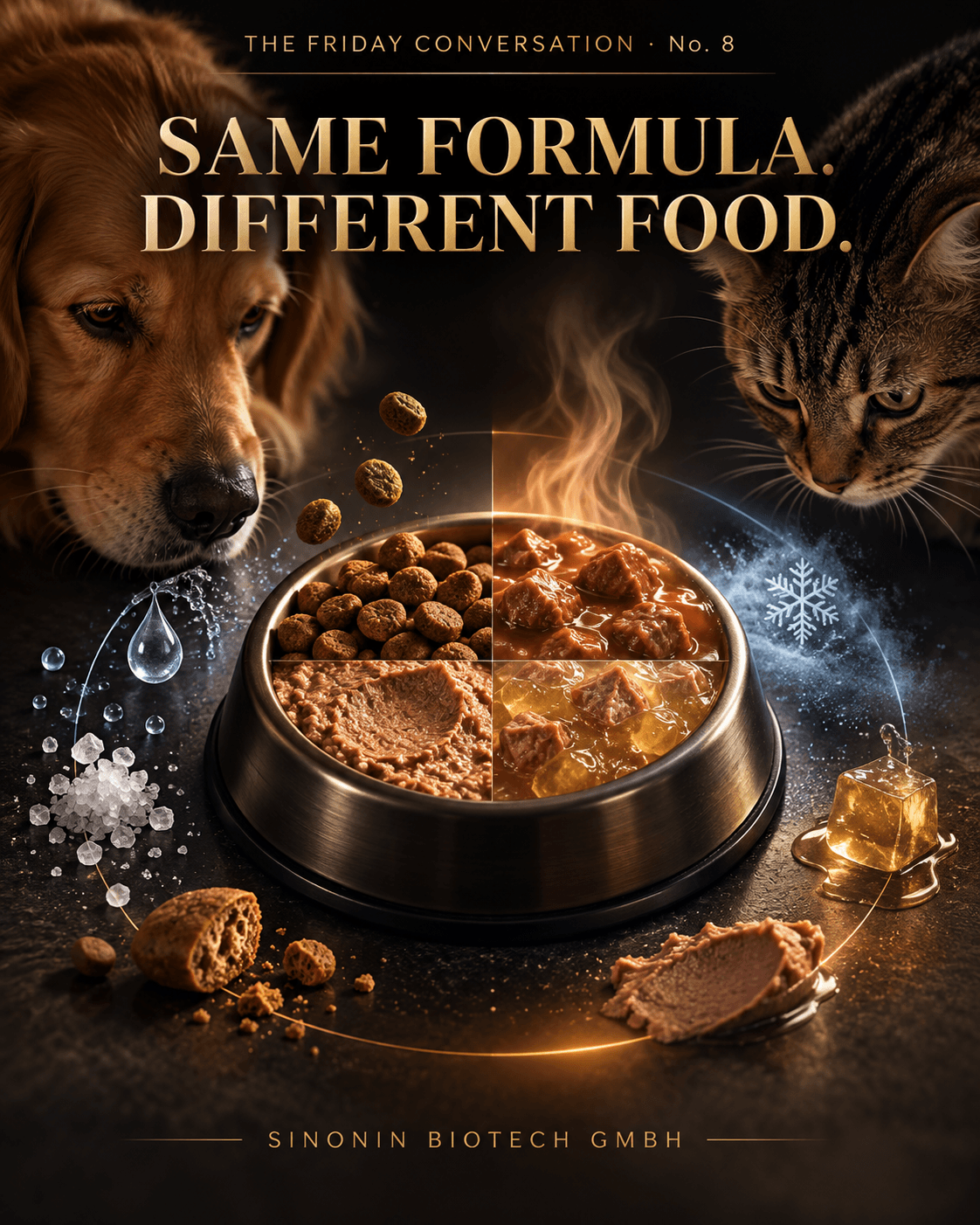
**The Physics of Petfood Palatability.** The same recipe, in a different physical state, is a different food to the animal. How much of palatability was never about the formula at all?
Take a single cut of beef, the same animal, the same muscle, and put it into four different kitchens.
In the first it is thrown onto a grill and left to char, and it comes off blackened at the edges, smoky, its surface a crust of browned reactions, eaten hot with the hands. In the second it is cut small and braised for hours until it collapses, and it arrives soft and yielding in a dark paprika gravy, the meat and the sauce by now almost one thing. In the third it is simmered gently and served in a clear rich liquor, tender pieces in a broth that carries its own separate warmth and smell. And in the fourth it is ground, salted, seeded with bacteria, stuffed and hung for months in a cool cellar until it is dense and dry and sharp, and then it is sliced thin and eaten cold.
A barbecue. A gulasch. Meat in gravy. A salami. The same animal stands behind all four. Yet no one who has eaten would call them the same food. No one wants the salami hot from a grill or the barbecue cold from a fridge in thin wet slices. We do not merely accept that these are different dinners. We feel it, in the mouth, without being taught.
So here is a question worth carrying into the rest of this essay, because the petfood industry answers it every day without quite noticing. If the same beef can become four foods that eat nothing alike, how much of what we call palatability was ever really about the recipe at all, and how much was about the state the food arrived in?
❦
Movement I · THE OBJECT IN THE BOWL
Now carry that cow into the pet food aisle, because the same thing has happened there, and we have been much slower to admit it.
The industry does not sell one wet food. It sells a chunk in gravy, and a chunk in jelly, and a pâté, and a mousse, and a loaf, and alongside them a dry kibble that shares more with a biscuit than with any of the wet formats. These are not simply five recipes. They may share the same nutritional intention, the same protein source, the same flavour direction, and yet become radically different physical objects that an animal meets in radically different ways. The chunk must be picked up and broken. The pâté yields at once. The gravy carries smell and moisture separately from the solid it surrounds, so that a cat can, and often does, drink the sauce and leave the meat, or the reverse. The kibble is hard and dry and can deliver a disproportionate part of its immediate palatability signal from a surface rather than from its body. To the formulator these may be one product line in several presentations. To the animal they are several foods.
And this is the quiet assumption the whole category rests on, that if we get the formula right the food will follow. But the animal never encounters the formula. It encounters an object, with a temperature, a texture, a moisture, a shape in the mouth, and a smell that the physical state either locks away or sets free. The recipe is what we wrote down. The object is what the animal actually met. We have spent a great deal of this series arguing about the first, and comparatively little about the second, and the animal has been judging the second all along.
None of this is a failure of formulation. It is simply a part of palatability that sits in the physics rather than the chemistry, and that has never had the attention the chemistry receives. So the question is not whether recipe matters. Of course it does. The question is the one we rarely put to ourselves plainly. How much of the animal’s verdict was shaped, from the first encounter, by the plain physical facts of how the food arrived?
The recipe is what we wrote down. The object is what the animal met.
❦
Movement II · THE TEMPERATURE OF THE MEAL
Start with the lever that costs almost nothing and is discussed almost never. Temperature. Not the heat of cooking, which the animal never sees, but the plain warmth or cold of the food in the moment it is set down.
Anyone who has kept a cat has watched the small drama. A pouch or a can straight from the fridge is opened and spooned out, and the cat approaches, lowers its head, and declines, and the food sits congealing while the animal looks at its owner with what feels like reproach. The same food, left to reach room warmth, or briefly warmed, is eaten. Nothing in the recipe changed between the refusal and the meal. Only the temperature did. And the question that ought to follow is the one the industry rarely asks out loud. If the same food can be refused cold and eaten warm, what exactly was the cold food failing to do?
One important part of the answer, as far as the science can currently show it, is that the colder food was giving the nose less to work with. When aging cats were offered the same chunks-in-gravy product at three temperatures, chilled to 6 degrees, at room temperature near 21 degrees, and warmed to 37 degrees, they preferred the warmer food in every comparison, and the warmest most of all. What makes the study worth dwelling on is what it ruled out. The gravy’s thickness barely changed across the three temperatures, so the difference was not that the cold food was harder to eat. What changed was the air above the bowl. Warming released markedly more of the volatile compounds that carry smell, including the sulfur notes associated with cooked meat and an acid tied to palatability, while some of the plant-like volatiles fell away. The cold food was not a different recipe. It was the same recipe with its aroma still locked inside it.
For a cat this may matter more than it would for us, because olfaction appears to be especially important in how a cat first investigates and accepts a food. Much of whether it approaches, and often whether it eats at all, seems to be settled by what reaches it through the air before a whisker touches the food. Warm the food and you set more of that aroma free; chill it and you hold much of it back, muffling the very signal the animal leans on for its first decision. The food that a cat meets cold is, in a real sense, a quieter food, and a quiet food asking a scent-led animal to commit is asking a great deal.
It is tempting to see an evolutionary fit here, since freshly killed prey is warm and not refrigerated, and a warmed food sits nearer that temperature than a chilled one. Whether a cat actually reads the warmth itself as part of a fresh-prey signal, rather than simply enjoying the fuller aroma that warmth releases, is a harder question than the tidy story admits, and one the evidence has not settled. What is clear is the direction, not yet the full reason.
And there is a deeper principle underneath the single study, one that belongs to physics rather than to cats. The molecules that carry smell are volatile, which is only to say that they leave the food and enter the air more readily as the food warms. Aroma release is temperature-dependent by its nature, and in humans a good deal of what we loosely call taste is really smell arriving by the back of the throat as we chew. How large that retronasal contribution is for a cat is not something we should assume from our own mouths, but the underlying physics, that warmth lifts volatiles from food, does not care whose nose is downwind. This is not a quirk of one product or one panel of elderly cats. It is true of a stew on a human stove and true of a chunk in gravy in a bowl, and it means the temperature of a food is never neutral. It is always either releasing the signal or holding it back.
Which raises something the industry knows and rarely says plainly. The animal does not choose the temperature. We do, or the room does. A pet has no fridge and no microwave and no sense of when the pouch was opened. It meets the food at whatever warmth we happen to have left it, and that warmth is doing quiet work on the aroma either way. Nor is warmth a free lever, because the same heat that frees the smell also hurries the spoiling. A wet food left out to reach an appetising warmth is also a wet food warming toward the temperatures at which it turns, and the window in which a bowl is both fragrant and safe is narrower than we like to admit. Temperature, in other words, is not a small convenience at the edge of palatability. It is a variable we control on the animal’s behalf, it governs both the smell and the safety of the meal at once, and the animal lives entirely at the mercy of the choice we make for it.
We did not change the recipe. We changed how loudly it could speak.
There is a fairness in noting that the effect has been studied particularly carefully in older cats, a population in which age-related changes to smell and taste may make food presentation especially consequential. But the finding points somewhere uncomfortable for how we test and how we feed. A palatability trial run at one temperature has measured the food at that temperature and nowhere else. A diet judged wanting in the bowl may have been judged wanting cold. How much of what we have recorded as a preference for a food was, without our noticing, a preference for a temperature?
❦
Movement III · HOW MUCH WATER
Temperature governs how loudly a food can speak. Water changes the language in which it speaks, and it does so along a spectrum most owners never think about even as they choose a point on it in the aisle.
At one end sits the dry food, a kibble holding less than about a tenth of its weight as water, closer in physical character to a biscuit than to anything an animal would meet in the wild. At the other end sits the wet food, most of its weight water, often three-quarters or more, soft and yielding and packaged in a can or a pouch because it cannot be stored any other way. And between them, less discussed and quietly interesting, sits the semi-moist food, somewhere around a fifth to a third water, soft enough to yield like meat yet stable enough to live on a shelf. Three foods, one nutritional intention, and three completely different physical propositions for the animal that has to eat them.
The industry has long observed that animals often take more readily to wet food than to dry, with semi-moist somewhere between, though the ranking is a tendency rather than a law and turns on the species, the individual, the product and the test. What is more certain, and more interesting, is that a good part of whatever difference exists is physics rather than flavour. Water is the medium in which taste-active substances dissolve and reach the tongue, so a wet food presents much of its flavour already in solution, ready to be perceived the moment it is in the mouth. Aroma is a subtler matter, because how much scent a food releases into the air depends not only on its water but on its fat, its proteins, its matrix and the particular volatile in question, and more water does not simply mean more smell. What water changes most is not whether a food has aroma but how the food organises and releases its sensory chemistry. A dry kibble is not silent; it carries scent in its headspace, which is part of why the outside of a kibble is where so much of its immediate palatability is deliberately placed. But a dry kibble carries relatively little flavour in solution until saliva begins to rehydrate it in the mouth, so a large part of its first, decisive impression has to be loaded onto its surface rather than built through its body.
That distinction, between sensory chemistry distributed through a food and sensory chemistry concentrated on its surface, is one of the most consequential facts in the category, and it follows directly from moisture. In a wet food, sensory chemistry can be distributed through the matrix. In a dry food, much of the immediate palatability signal is deliberately concentrated at the surface, so the animal meets that layer first, in the first second, dry against the tongue. The two formats are not louder and quieter versions of one food. They are two different architectures of flavour, and moisture is a large part of what decides which architecture you are building.
The flavour of a wet food is largely in the food. Much of the immediate flavour of a dry food is deliberately put on it.
The semi-moist food is the most ingenious point on the spectrum, and the reason repays a moment. Its appeal is softness and higher moisture, closer to the mouthfeel of meat than a hard kibble can manage, and yet it survives on a shelf without a can. The key is that the important number is not simply how much water a food contains, but how much of that water is free to participate in chemistry and support microbial growth, which is measured as water activity. A food can hold a good deal of water and still keep well if enough of that water is bound rather than free. Water activity is not the whole of the trick, because shelf stability also leans on solutes, acidity, preservation and packaging together. Salt is one of those solutes, and it is worth naming here because it is quietly doing physical work long before anyone asks whether it can be tasted. Dissolved in the food, salt lowers the activity of the water present, making less of it available to the microorganisms that would otherwise exploit it, which is part of why salting has preserved meat for as long as people have wanted meat to last. In a pet food, salt is one of the levers that helps hold a soft, moist texture at a moisture that would otherwise spoil. Its first job, in other words, is not flavour at all. It is physics. Water activity, then, sits at the heart of the compromise, and it lets a semi-moist food strike a clever balance, wet enough in the mouth to please the animal, stable enough in the microbial sense to keep. It shows how far the physical form alone, quite apart from the recipe, can be engineered to change what the animal experiences.
So the question that closes this lever is not which format is best, because that depends on the animal, the owner, the budget and the shelf. The question is subtler and more uncomfortable. When an animal prefers the wet food to the dry, as animals so often do, how much of that was a verdict on the flavour we formulated, and how much was a verdict on water itself, changing the way that sensory chemistry was organised, released and encountered?
❦
Movement IV · THE SHAPE OF THE MOUTHFUL
There is a soft, semi-moist dog food, strongly aromatic and easy to mould, that anglers have quietly used for years as fishing bait. It is not hard to see why. It holds together on a hook, it releases its scent into the water, and it can be pressed into whatever shape the moment requires. Not one of those virtues has anything to do with the dog it was formulated for. They are pure physics, the properties of the object rather than the recipe, and they are compelling enough to work on a fish. A food designed for one species, doing some of its most persuasive work underwater, on another that it was never meant to feed. If the physical form of a food can do that, we should take seriously what it is doing inside the mouth it was actually built for.
Because the animal does not swallow a formula. It takes hold of an object, of a particular size and hardness and shape, and its mouth has to do something with it, and what the mouth can comfortably do differs between our two species. Dogs tend to eat quickly and bolt much of what they are given. Cats tend to take smaller bites and spend longer over a meal, and their jaws do not move sideways to grind; their teeth are built to shear and tear. That anatomy is part of why texture, size and shape appear to weigh more heavily for cats than for dogs, and why a cat is quicker to reject a piece that does not sit right in the mouth. For the cat, texture is often not a finishing touch on palatability. It can be a gate the food has to pass through before taste is ever consulted.
The consequences are surprisingly specific. How a kibble behaves in the mouth is a question of food mechanics, of its hardness and brittleness and the force needed to fracture it, and those depend on many things at once, on density and porosity and moisture and the way it was made, as well as on its size and shape. A cat that must break every piece with shearing teeth is sensitive to the result. Shape matters too, and not decoratively; a kibble with sharp edges can be awkward to grasp and uncomfortable to bite, and there are indications that cats favour rounded, easily handled forms, some so specifically that flat-faced breeds are offered kibbles shaped to be caught more easily by a short muzzle. Lower-density pieces that fracture readily tend to be appreciated. None of these are matters of flavour. They are matters of how the object meets the mouth, and where the fit is wrong the flavour may never get its hearing.
For the cat, texture is not the finish on palatability. It is the gate it has to pass first.
Salt belongs in this movement too, and not for the reason a human cook would expect. On our side of the bowl, salt earns its place partly by changing the food as a physical material, drawing out and dissolving proteins, altering how a mixture binds and sets and holds together, shaping the very texture we have been talking about. But cross to the animal’s side and the familiar human logic loosens. Experimental work suggests that cats do not show the straightforward attraction to added salt that humans do, and that sufficiently high concentrations become aversive to them, so that even a sodium-depleted kitten will not reliably choose a salted diet over an unsalted one. One plausible explanation lies in their carnivorous history. An animal whose ancestral diet supplied its sodium through animal tissue may have faced a very different selection pressure from omnivores repeatedly meeting sodium scarcity, though whether that fully explains the feline response is harder to establish. What matters here is the practical point. Salt can be technologically important to the food, doing real work on its water and its texture, without functioning as the simple flavour reward a human cook would assume, which is one more sign of how far the animal’s palate has diverged from the one we keep, without noticing, projecting onto it.
We salt our food for pleasure. For the cat, salt plays by different rules.
Wet food is where physical form becomes almost a language of its own, because here the same nutritional intention can be presented as a smooth pâté that yields at once, or a firm loaf that must be broken, or discrete chunks suspended in a gravy, or the same chunks set in a jelly, or a whipped mousse. These are not decorative distinctions. A pâté asks nothing of the teeth and gives its flavour immediately. A chunk asks to be seized and sheared and holds its flavour in a body the animal has to work into. And the chunk formats do something stranger still, because the chunk and its surrounding gravy or jelly are, in effect, two foods in one bowl, a solid and a sauce with their own separate textures and their own separate loads of smell and flavour. Watch a cat lick every trace of gravy from around the chunks and walk away, or clean up the chunks and leave the jelly congealing at the edges, and you are watching something precise. On the label there was one product. In the formulation system there was one recipe. In the bowl, the animal ran its own separation and chose. The manufacturer made one food. The cat found two.
The manufacturer made one food. The cat found two.
So the uncomfortable question that this lever leaves is the same one the others keep raising, in a new costume. When a cat turns from a food, we are inclined to record that it did not like the taste. But how often had the taste even been reached? How often was the refusal a verdict passed at the lips, on a piece too large or too hard or too sharp or too oddly shaped to be worth the trouble, delivered long before a single flavour molecule was ever given the chance to make its case?
❦
Movement V · THE ACID EDGE
The last of the physical levers is the quietest, and the one that sits closest to the border between physics and chemistry, which is why it is worth handling carefully. The acidity of a food, its pH, is not a flavour in the way that a savoury peptide is a flavour. It is a condition of the whole food, a property of its water and its salts, and it shapes how the food is perceived without being an ingredient the animal could point to.
Cats, the palatability literature suggests, do care about it. Given a choice they tend to prefer a mildly acidic food over a neutral or an alkaline one, and acidulants are used in cat foods partly for that reason. One reading of why is evolutionary, that a carnivore eating fresh meat and organs is eating mildly acidic material, so a food in that range reads as right. That is a plausible interpretation rather than a settled fact, but the preference itself is real enough to matter to anyone formulating for cats. So far this looks like one more thing we could simply add and be done with.
But the lever has a hinge in it, and the hinge is the interesting part. The same cat that is drawn to a mild acidity will refuse a strong sourness. A sharply sour taste is aversive to cats, as it is to many animals, one of the signals a cautious eater treats warily. It is tempting to tie this neatly to spoilage, to say that sourness means rot, but the chemistry of decay is not that tidy. Spoiling food can turn more acidic when certain bacteria produce acids, and it can turn more alkaline when others release amines and ammonia from breaking-down protein, and it throws off sulfur compounds and other volatiles besides. Rising sourness is one possible sign among several, not a clean dial from fresh to foul. What we can say more safely is narrower and still useful. Cats like a little acid and reject a lot of it, so pH is not a setting you can push in one direction for more reward. It is a window, and both of its edges matter.
There is, separately, a real fact about acid and keeping. Lowering a food’s pH is one of the oldest ways of preserving it, because many of the microbes that spoil food grow poorly as acidity rises, which is why acidified and fermented foods keep where neutral ones do not. So on the food’s side, acidity is partly a preservation tool. Whether the animal’s own taste for mild acidity evolved as a freshness cue, or for some other reason, or as a mixture of causes, is less certain than the neat story would have it. It is enough to notice that acid does real work on two fronts at once, on how long a food lasts and on whether a cat will accept it, and that a formulator has to satisfy both.
Step back and the physical levers we have walked through share a quality worth naming. Each of them is a case of the same thing: physics deciding how the chemistry of a food reaches the animal, or whether it reaches the animal at all. Temperature governs how much of the aroma leaves the food for the air. Water, and how much of it is free, governs how flavour dissolves and travels and how the food keeps. Texture and geometry govern whether the mouth can comfortably process the piece at all. Phase, the chunk and its separate sauce, governs whether the animal can take one part and leave another. And pH shifts taste, protein state, preservation and the food’s chemical equilibria all together. None of these is the flavour. All of them decide what becomes of the flavour on its way to being judged. The recipe lists what is in the food. Physics settles what the animal actually gets.
We have brushed against this before in these Conversations, and only now does it show its shape. An earlier one followed fat down the road of oxidation and found that the same molecule which signals a fresh kill signals rancidity a few steps later, so that the animal is not reading whether the fat has oxidised but how far along the reaction has run. That was a story about how a chemical signal is presented to the animal in time, and this is the same story told in space and state, about how a whole food is presented to the animal in the physical form we give it. In both, the thing we call palatability turns out to live not purely in the composition, but in the meeting between a food in a particular state and an animal equipped to read it.
And here the physical lever quietly becomes a clinical one, which is a pattern this series keeps meeting. A cat’s urinary health depends on the acidity of what it eats, because a diet that pushes the urine too far in one direction invites one kind of stone and too far in the other invites another. So the pH of a cat food is never chosen for palatability alone. It is chosen at the meeting point of what the cat will find attractive, what will keep it from harm, and what the food’s own ingredients and preservation will allow. The window that palatability wants and the window that health requires are not guaranteed to be the same window, and the formulator lives in the overlap.
There is a last thing pH reveals, and it reframes the whole essay. The cat works with a relatively sparse gustatory apparatus, only a few hundred taste buds where a dog has thousands and a human more still, and it lacks a working sweet receptor entirely. Yet it remains one of the most discriminating animals we formulate for, the quickest to refuse, the hardest to please. That is not a contradiction. It is a warning against equating palatability with taste. The tongue is only one member of the committee, and for the cat, evidently, not the loudest. Smell, temperature, texture, geometry, the acidity the animal will accept only within a narrow band, the physical state of the food in every respect we have walked through: all of them get a vote. And all of them are, in one way or another, physics.
So the question this final lever leaves is the largest one. We have spent a career, as an industry, refining the flavour of foods for an animal that judges as much by other means as by the tongue. How much of the palatability we have been chasing was ever really in the flavour at all, and how much was waiting, all along, in the physical state of the food, in the plain facts of how warm it was, how wet, how hard, how shaped, and how sour, before the tongue was ever asked for its weak and final opinion?
❦
Movement VI · THE SAME COW
Return, at the end, to the four kitchens.
The barbecue and the gulasch and the salami were the same cow, and no one who ate them was fooled into thinking they were the same dinner. We knew, in the mouth, that the fire and the braise and the ferment had made three different foods out of one animal, and we never once mistook the recipe for the meal. We grant ourselves that distinction without a thought. We have been slower to grant it to the animal in the bowl.
Because the pet food industry has spent most of its ingenuity, and most of these Conversations, on the recipe: the protein, the fat, the palatant, the chemistry of the thing. All of that is real and none of it is wasted. But the animal has never eaten the recipe. It has eaten an object, warm or cold, wet or dry, soft or hard, sharp or mild, and it has judged that object with its whole body, its nose and its mouth and its long inheritance of caution, well before the tongue was ever consulted. The formula was our question. The object was the animal’s answer.
None of this asks us to think less of flavour. It asks us to notice how much of what we credited to flavour was being carried, quietly, by the plain physics of the food. And it suggests a way of holding the two together that does not make them rivals. Chemistry supplies the signals a food can send, the savoury peptide, the fresh-kill volatile, the amino acid the tongue is tuned to. Physics decides when, where and in what state those signals reach the animal, or whether they reach it at all. Physical form, in this light, is the delivery architecture of palatability. Chemistry writes the message. Physics controls its delivery.
Chemistry writes the message. Physics controls its delivery.
And it is worth pausing on the strangest thing of all, which is how the animal reads that delivery. The cat carries no pH electrode and no thermometer, no hygrometer to weigh the moisture and no instrument to measure the hardness of a piece or the water activity of a paste. It does not measure these properties one at a time. It encounters their consequences together, in the few seconds between approaching the bowl and eating or turning away. Our instruments separate the food into variables, temperature here, moisture there, acidity, hardness, geometry, each on its own dial. The animal integrates them into behaviour. And that behaviour is the only answer we ultimately receive. The food arrives whole. The animal answers whole. We are the ones who divide both into measurements.
We have spent these Conversations taking the food apart. We have looked at the volatile that announces a fresh kill, the fat that carries its own clock of freshness, the plasma that holds a chunk together, and the enzyme that cuts a protein until savour and bitterness begin to trade places. All of it matters, and none of it reaches the animal in the abstract. It arrives warm or cold, wet or dry, dissolved or held fast, on a surface or inside a body, in a chunk that fractures, a gravy that can be licked away, a jelly that keeps its water still, or a pâté in which there is nowhere for one part to hide from another. The same cow can be four dinners. The same formula can be five foods, because a formula has no temperature, no bite and no mouthfeel until we turn it into something an animal can actually eat.
The recipe tells us what we made. The animal only ever meets what it became.
References
1. Eyre, R., Trehiou, M., Marshall, E., Carvell-Miller, L., Goyon, A. & McGrane, S. (2022). Aging cats prefer warm food. Journal of Veterinary Behavior 47:86-92. doi:10.1016/j.jveb.2021.09.006
2. Bradshaw, J.W.S., Goodwin, D., Legrand-Défretin, V. & Nott, H.M.R. (1996). Food selection by the domestic cat, an obligate carnivore. Comparative Biochemistry and Physiology Part A 114(3):205-209. doi:10.1016/0300-9629(95)02133-7
3. Cook, N.E., Rogers, Q.R. & Morris, J.G. (1996). Acid-base balance affects dietary choice in cats. Appetite 26(2):175-192. doi:10.1006/appe.1996.0014
4. Yu, S., Rogers, Q.R. & Morris, J.G. (1997). Absence of a salt (NaCl) preference or appetite in sodium-replete or depleted kittens. Appetite 29(1):1-10. doi:10.1006/appe.1996.0088
5. Fettman, M.J., Coble, J.M., Hamar, D.W., Norrdin, R.W., Seim, H.B., Kealy, R.D., Rogers, Q.R., McCrea, K. & Moffat, K. (1992). Effect of dietary phosphoric acid supplementation on acid-base balance and mineral and bone metabolism in adult cats. American Journal of Veterinary Research 53(11):2125-2135.
6. Hagen-Plantinga, E.A., Orlanes, D.F., Bosch, G., Hendriks, W.H. & van der Poel, A.F.B. (2017). Retorting conditions affect palatability and physical characteristics of canned cat food. Journal of Nutritional Science 6:e23. doi:10.1017/jns.2017.17
7. Calderón, L.A. et al. (2024). Measuring palatability of pet food products: sensory components, evaluations, challenges, and opportunities. Journal of Food Science 89(9):5359-5382. doi:10.1111/1750-3841.17511
8. Shin, T., Nahm, I., Maeyama, T., Miyazaki, J., Matsuo, H. & Yu, Y. (1995). Morphological study of the laryngeal taste buds in the cat. The Laryngoscope 105(12):1315-1321. doi:10.1288/00005537-199512000-00010
❦
About the Author
Dr. rer. nat. habil. Dr. Seronei Chelulei Cheison is the founder and Chief Executive Officer of Sinonin Biotech GmbH, where he works with petfood companies on palatant sourcing strategies, the innovation of palatability enhancers, and the design of palatability assessment. A trained food enzymologist, he led alternative protein and palatant development at Mars Petcare before founding Sinonin, and his research on protein chemistry spans two decades, a doctorate from Jiangnan University, and a habilitation from the Technical University of Munich.
❦
Sinonin Biotech GmbH is a partner in the ZEST project (Grant Agreement No. 101157382) and the PROSCALE project (Grant Agreement No. 101288362), both funded by the Circular Bio-based Europe Joint Undertaking (CBE JU) under the European Union’s Horizon Europe research and innovation programme. Views and opinions expressed are those of the author only and do not necessarily reflect those of the European Union or CBE JU. Neither the European Union nor the granting authority can be held responsible for them.
- Cat Nutrition
- dry vs wet pet food
- food temperature
- food texture
- kibble
- minerals
- moisture content
- pet food formulation
- pet food palatability
- pet food physics
- Pet Nutrition
- pH
- salt
- Sensory Science
- water activity